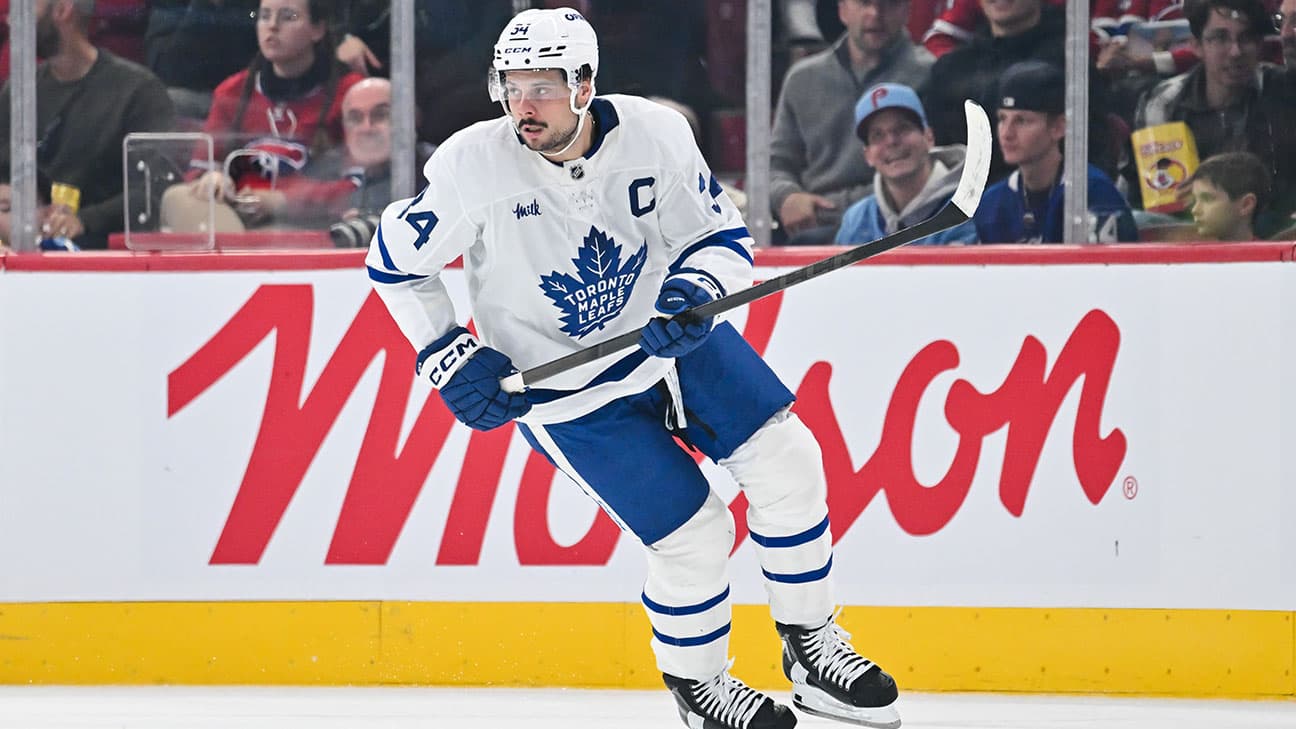
Photo: NHL.com
Auston Matthews Player Tiers Drop: What the League Thinks Now
Table of Contents
The Auston Matthews player tiers verdict is in, and it is the first genuinely unflattering thing the rest of the NHL has said about him on the record in years. In The Athletic's annual tier project — built from anonymous polling of executives, coaches and scouts around the league — Matthews slid out of the top group for the first time since 2022, landing in the second tier, labelled "franchise," in group A. He had been a first-tier player in each of the previous three editions. He is still the highest-ranked Maple Leaf. He is no longer in the conversation the top tier is having.
Five Toronto players appear in the exercise: Matthews, William Nylander, Matthew Knies, Darren Raddysh and John Tavares. That is a reasonable number for a team that missed the playoffs. It is also a smaller and less top-heavy group than the one Toronto brought into any of the previous four seasons, and the anonymous commentary attached to it is worth reading carefully, because it is the closest thing to an honest league-wide appraisal of what Toronto actually has.
What the tiers actually said about Matthews
The drop is one full tier, and the reasoning was not subtle. "Based off just last year, I think Auston is a little bit high," one coach said — which is a remarkable thing to say about a player who was just placed in a tier called franchise. Not that he was ranked correctly. That he was ranked generously.
That is the tell. The league is not arguing about whether Matthews is elite in the abstract. It is arguing about whether the last two seasons are the new baseline. Two injury-shortened, production-suppressed years is enough of a sample that voters have started treating the 69-goal version of Matthews as historical rather than predictive.
We have written repeatedly that every projection on Matthews is a bet on his health, and this is the same bet expressed by a different set of voters. The NHL Network put him eighth among centres this summer. The Athletic's panel has him outside the top tier. Those are two different methodologies reaching the same conclusion, which is usually how you know a conclusion is real.
The Nylander comments are the interesting ones
Nylander landed in the third tier — "all-star," group A — and the quotes about him carry an edge that the ranking does not. "He's in the top five or so players in the league when he really plays his best," one executive said, adding that "his skating, edge work and ability to hold onto the puck is so freaking good."
Read that twice. A rival executive believes Nylander has top-five ability, and voted him into the third tier anyway. The gap between those two positions is the entire William Nylander discourse compressed into one paragraph: the talent has never been the question, the consistency of application has.
The numbers actually argue for him. Nylander put up 30 goals and 79 points in 65 games last season, a rate of 1.22 points per game that was the best of his career, on a team that missed the playoffs. He turned 30 in May and is entering the third year of an eight-year contract. If you want to be pessimistic, that is a player whose peak years are being spent on a team that is not contending. If you want to be optimistic, it is the most reliable offensive player Toronto has, and the one Leaf whose 2025-26 season nobody has to make excuses for. We argued last week that he should have a letter on his sweater, and nothing in this exercise changes that.
Knies, Raddysh and Tavares tell you where the roster really is
The three other Leafs on the board are the honest part of the picture.
Matthew Knies making the list at all is a meaningful marker for a player who has been the subject of trade speculation for most of a calendar year. He put up 23 goals and 43 assists last season and has moved from "promising winger attached to Matthews" to a player rival teams evaluate on his own terms. That cuts both ways — it is why the trade rumours existed, and it is why his contract is arguably Toronto's best asset.
Darren Raddysh appearing is the more surprising inclusion, and it reflects a defenceman who arrived with a specific skill set the analytics community rated higher than the mainstream did. Tavares, at 36, remains on the board on the strength of a career and a role rather than a trajectory.
What is missing matters as much. Morgan Rielly is not there. Jake McCabe is not there. The goaltenders are not there. Toronto's defence corps and crease — the two areas that decided last season — do not register with the league's evaluators at all. That is not a snub. That is a description.
Why this ranking matters more than most rankings
Preseason lists are usually content, not information. This one is different in a narrow but real way: the respondents are the people who make trades. When an anonymous executive says Matthews might be ranked a little high, that executive is also the person who would have to give up assets to acquire a player like Matthews. Their opinion has a price attached to it.
That is why this exercise has practical value for John Chayka. It is a live read on what the league thinks his players are worth — and Toronto's general manager has spent the summer discovering that his trade market is narrow for other reasons. With only about eight players on the roster free of trade protection, the valuations of the protected stars are somewhat academic. Still, if the league now sees Matthews as a second-tier player, that shapes everything from extension talks to what a hypothetical retool would return.
The case that the panel is wrong
Here is where LeafsLurker parts company with the consensus. The coach quote — "based off just last year" — is an argument against itself. Basing a franchise-player evaluation off one season is exactly the analytical error these projects are supposed to avoid.
Matthews turns 29 on Sept. 17, in a league where centres of his profile routinely produce into their early thirties. The decline in his numbers tracks almost perfectly with games missed and with playing hurt, not with a loss of the specific skills that made him great: the release, the deception, the shot from the left circle that nobody has ever solved. Skills like those do not evaporate in 24 months. Health is a real risk and we have said so repeatedly. But there is a meaningful difference between "he might not be available" and "he is no longer that player," and the tier drop conflates them.
There is also a context problem. Matthews spent last season on a team with a collapsing defence, a goaltending crisis and a coaching staff that has since been replaced wholesale. Evaluating a player through that filter and calling the result a talent judgment is generous to the filter.
What Matthews can do about it
The answer is boring and it is the only one: play 75 games.
Everything else follows. Toronto's power play was 25th in the league last season and is being rebuilt under Daniel Alfredsson. The 84-game schedule creates more opportunity in raw terms. Gavin McKenna arriving as a genuine offensive threat should, if the deployment is right, give Matthews the kind of linemate he has not had since Mitch Marner left. There is a plausible path to a 50-goal season in there, and a 50-goal season ends this conversation immediately.
The less plausible path is the one where he plays 62 games again, produces at a first-line-but-not-elite rate, and this tier becomes the floor rather than the dip. That is the version where the questions stop being about Matthews' health and start being about Toronto's next four years.
What's next
Camp opens in the coming week under new rules that cap veterans at 13 days and two exhibition appearances, and Matthews will play his first game that counts on Sept. 29 against Montreal. Rankings are noise until the puck drops; then they become the baseline that everyone measures against.
Our read is that the panel got the direction right and the magnitude wrong. Matthews should not have been a first-tier player coming off last season. He is also not, on talent, a second-tier one. He is a first-tier player with a health problem, which is a different sentence with different implications — and how it resolves is the single biggest variable in Toronto's Atlantic Division outlook. Track it all season on our standings page.
Frequently Asked Questions
Where did Auston Matthews rank in The Athletic's 2026 player tiers?
Matthews was placed in the second tier, labelled "franchise," in group A. That is down a full tier from the top group, where he had been ranked in each of the previous three editions of the exercise. He was still the highest-ranked Maple Leaf.
Which Maple Leafs made The Athletic's player tier list?
Five Toronto players appeared: Auston Matthews, William Nylander, Matthew Knies, Darren Raddysh and John Tavares. No Maple Leafs goaltender was included, and neither Morgan Rielly nor Jake McCabe made the board.
What tier is William Nylander in?
Nylander was placed in the third tier, labelled "all-star," in group A. One executive polled said he is "in the top five or so players in the league when he really plays his best," praising his skating, edge work and puck protection.
What were William Nylander's stats in 2025-26?
Nylander recorded 30 goals and 79 points in 65 games, a rate of 1.22 points per game that was the best of his NHL career. He led the Maple Leafs in scoring, turned 30 in May 2026, and is entering the third season of his eight-year contract.
Why did Auston Matthews drop in the player tiers?
The polling reflects two injury-affected seasons in which his goal production fell well short of his peak. One coach told The Athletic that "based off just last year, I think Auston is a little bit high," suggesting some voters felt even the second tier was generous.
How are The Athletic's NHL player tiers determined?
The project is built from anonymous polling of NHL executives, coaches and scouts, who sort players into tiers and groups rather than a strict numbered list. Because respondents are the people who make and evaluate trades, the results function as a rough market read on player value.
What does Auston Matthews need to do in 2026-27?
Play a full season. Availability, not skill, has driven his statistical decline, and the 84-game schedule plus a rebuilt power play under Daniel Alfredsson give him more opportunity than he had last year. A 50-goal season would end the tier debate outright.


