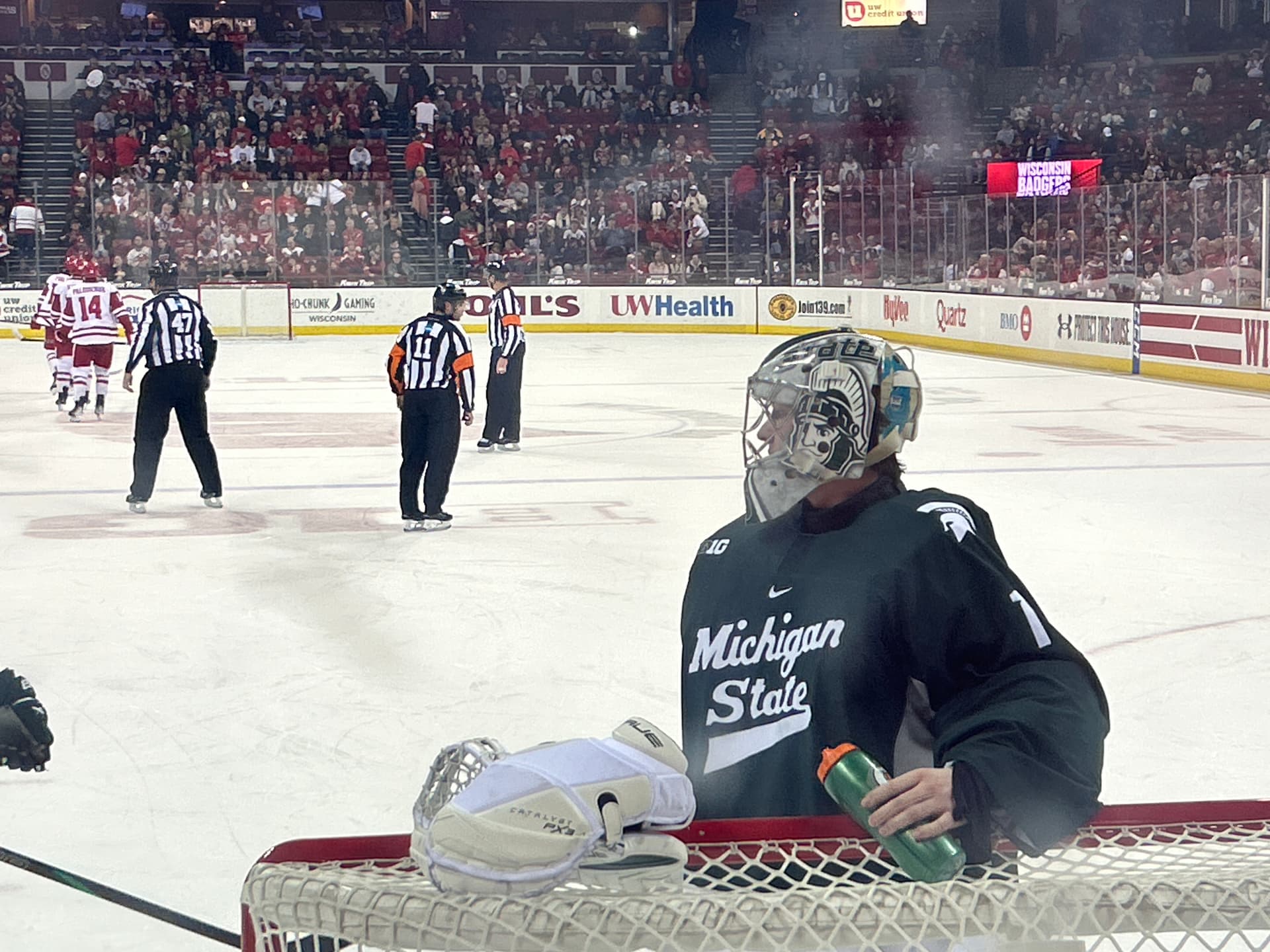
Photo: SecretName101, Wikimedia Commons (BY-4.0)
Samuel Hlavaj Was an Olympic Star. He's Toronto's Fourth Goalie
Table of Contents
Samuel Hlavaj is the best goalie in Toronto nobody is talking about
Samuel Hlavaj was one of the best goaltenders at the 2026 Winter Olympics. Seven months later he is the fourth goalie on the Toronto Maple Leafs' depth chart, on an $850,000 contract, expected to back up in the American Hockey League. He was also one of the standouts of the second day of on-ice sessions at Maple Leafs training camp.
That combination of facts is strange enough to be worth a look, because the gap between what Hlavaj did in Milan and where he sits in Toronto is the widest of anyone in the organization.
The signature performance was Slovakia's opener against Finland, a 4-1 win in which Hlavaj made 39 saves, 18 of them in the first period alone. He carried Slovakia to the bronze medal game. For a goaltender who had never played an NHL game, on a team nobody expected to reach the medal round, it was as loud a two weeks as an unknown can have.
How he ended up here
Hlavaj, 25, spent two seasons in the Minnesota organization after signing with the Wild in April 2024, playing 58 games for Iowa in the AHL without ever getting an NHL call. Minnesota released him this summer. He became an unrestricted free agent and signed a one-year, $850,000 deal with Toronto — a depth signing folded into a batch of them that we covered at the time without much fanfare.
The 6-foot-4 Slovak is one of six goaltenders Toronto brought to camp alongside Artur Akhtyamov, Ken Appleby, Sergei Bobrovsky, Timofei Obvintsev and Anthony Stolarz. On paper he is behind all the ones who matter.
His AHL body of work is the reason. Hlavaj's 2025-26 season in Iowa was not strong, and a goaltender with a mediocre professional track record does not leapfrog a depth chart on the strength of an Olympic fortnight. Toronto signed him as insurance, not as a prospect.
The case that the Olympics were not a fluke
Here is the argument in his favour, and it is not nothing.
Goaltending is the position where small samples lie most often, in both directions. A poor AHL season for a goalie playing behind a poor AHL team tells you less than the same sample would for a skater. Hlavaj's Iowa numbers came on a club that was not good in front of him, and the AHL's save-percentage environment is notoriously noisy.
What the Olympics showed was a goaltender who did not shrink. Thirty-nine saves against Finland in a tournament opener, in front of a national team with no margin, is a specific kind of test. Goalies who thrive in big moments are a real category, even if they are impossible to identify in advance.
The Leafs' goaltending staff appears to have noticed. Hlavaj drew attention in the second day of camp sessions, which is the only evidence available this early and is worth exactly what early camp evidence is usually worth. Still — the organization is watching.
The path to the NHL is narrower than it looks, and also wider
Toronto's crease for 2026-27 is settled. Stolarz is the starter, healthy after last season's groin trouble, and Bobrovsky arrived on a three-year, $21 million contract to share the workload in a reunion of the tandem that won a Cup in Florida. We broke down the tandem when the signing happened. Neither is going anywhere.
Behind them, Akhtyamov is the organization's actual goaltending prospect and the presumed Marlies starter, with a developmental path Toronto has been careful to protect. Hlavaj is slotted as his backup.
But consider the ages involved. Bobrovsky turns 38 during the season. Stolarz has missed time in each of the past two years. Toronto is running a tandem with a combined age north of 70 and a recent injury history in both halves. The probability that the Leafs need a third goaltender at some point in an 82-game season is not low — it is closer to a certainty.
When that call comes, the club will choose between a 24-year-old prospect it does not want to rush and a 25-year-old veteran who just stonewalled Finland at the Olympics. That is not a difficult choice to predict.
The Marlies crease is its own competition
The framing of Hlavaj as insurance undersells what is happening one level down. Toronto's AHL affiliate has a real goaltending situation this season, and it matters more than it usually would because the NHL tandem is old enough that the affiliate is effectively the third and fourth lines of defence.
Akhtyamov is the priority. He is the only goaltender in the system Toronto genuinely projects into an NHL starting job, and the organization has been deliberate about giving him volume rather than rushing him. A crowded Marlies crease works against that. A backup who is too good creates a problem the development staff does not want.
Which is the uncomfortable subtext of Hlavaj's camp. If he outplays Akhtyamov in Toronto, the club has to choose between protecting a prospect's development curve and playing the goalie who is stopping more pucks. Those are not the same decision, and organizations get it wrong in both directions all the time.
What an Olympic run is actually worth
It is worth being precise about how much weight to put on February. Best-on-best tournaments are short, the sample is tiny, and the goaltender who gets hot is frequently the one nobody had heard of. That is a structural feature of the format, not evidence of a hidden star.
The honest read on Hlavaj is that the Olympics did not prove he is an NHL goaltender. They proved he is capable of playing at that level for stretches, which is a lower bar and still a useful one. Plenty of career AHL goalies never clear it.
What the tournament did do was change how he is evaluated. Before Milan, Hlavaj was an unsigned 25-year-old with a weak AHL season and no NHL games. After it, he was a free agent every team's pro scouting staff had watched. Toronto got him for $850,000 because the market still priced him on the body of work rather than the highlight. That is usually where value lives.
What $850,000 actually buys
The contract is the quiet part of why this signing is smart. Toronto has no cap space — the roster is built around Max Domi's absence and long-term injured reserve, a structure we have tracked on the contracts page all summer. An $850,000 cap hit is the cheapest form of emergency goaltending available.
Compare it to the alternative. A team forced to acquire a goaltender in November pays a real price, usually a draft pick and often salary it cannot fit. Chayka spent less than a million dollars in July to make that call unnecessary.
This is the kind of transaction that never gets credited when it works, because the counterfactual is invisible. It gets noticed only if Hlavaj has to play and cannot.
What to watch in the preseason
- Which half of the split squad he draws. Bobrovsky starts Saturday in Toronto. The goaltender who gets the Montreal game and the ones who follow against Ottawa tells you how the staff ranks the depth.
- Whether he beats out Appleby. Ken Appleby is the veteran AHL option. If Hlavaj takes the Marlies backup job outright, he becomes the de facto third NHL goalie by default.
- Rebound control. The knock on big goaltenders who post loud highlight numbers is that they generate their own traffic. Thirty-nine saves is a great night. It is also, sometimes, a sign of a goalie who made 10 saves he should not have had to.
What's next
Toronto has three preseason games left after Saturday's split-squad doubleheader against Montreal — one more against the Canadiens and two versus Ottawa — before the roster is set for the Sept. 29 opener. Hlavaj will almost certainly start the season with the Marlies.
That is not the same as being irrelevant. Toronto's season rests on two goaltenders who have both missed time recently, and the fourth name on the list is a man who was among the best in the world for two weeks in February. Depth signings are boring right up until the moment they are the whole story.
Frequently Asked Questions
Who is Samuel Hlavaj?
Hlavaj is a 25-year-old Slovak goaltender listed at 6-foot-4 who signed a one-year, $850,000 contract with the Maple Leafs in the summer of 2026 after being released by the Minnesota Wild. He starred for Slovakia at the 2026 Winter Olympics despite never having played an NHL game.
How did Samuel Hlavaj play at the 2026 Olympics?
He was among the tournament's best goaltenders, making 39 saves — 18 in the first period — in Slovakia's 4-1 win over Finland in its opening game. He backstopped Slovakia to the bronze medal game in Milano Cortina.
Where will Samuel Hlavaj play in 2026-27?
He is expected to open the season with the AHL's Toronto Marlies, backing up Artur Akhtyamov. He is the fourth goaltender on the Maple Leafs' organizational depth chart behind Anthony Stolarz, Sergei Bobrovsky and Akhtyamov.
Who are the Maple Leafs' goalies for 2026-27?
Anthony Stolarz is the starter, with Sergei Bobrovsky signed to a three-year, $21 million deal as the other half of the tandem. Artur Akhtyamov is the top prospect and projected Marlies starter, with Samuel Hlavaj as depth. Toronto brought six goaltenders to camp.
What is Samuel Hlavaj's cap hit?
His one-year contract carries an $850,000 cap hit for the 2026-27 season. That is close to the league minimum and is the cheapest form of emergency goaltending insurance available to a team with no salary cap space.
Did Samuel Hlavaj ever play in the NHL?
No. He has not appeared in an NHL game. He spent two seasons in the Minnesota Wild organization after signing in April 2024, playing 58 games for the AHL's Iowa Wild before being released in the summer of 2026.
Why did the Maple Leafs sign Samuel Hlavaj?
Toronto signed him as inexpensive goaltending depth. With Bobrovsky turning 38 during the season and Stolarz having missed time in each of the past two years, the club needed a credible third option who would not require a midseason trade or cap space it does not have.


