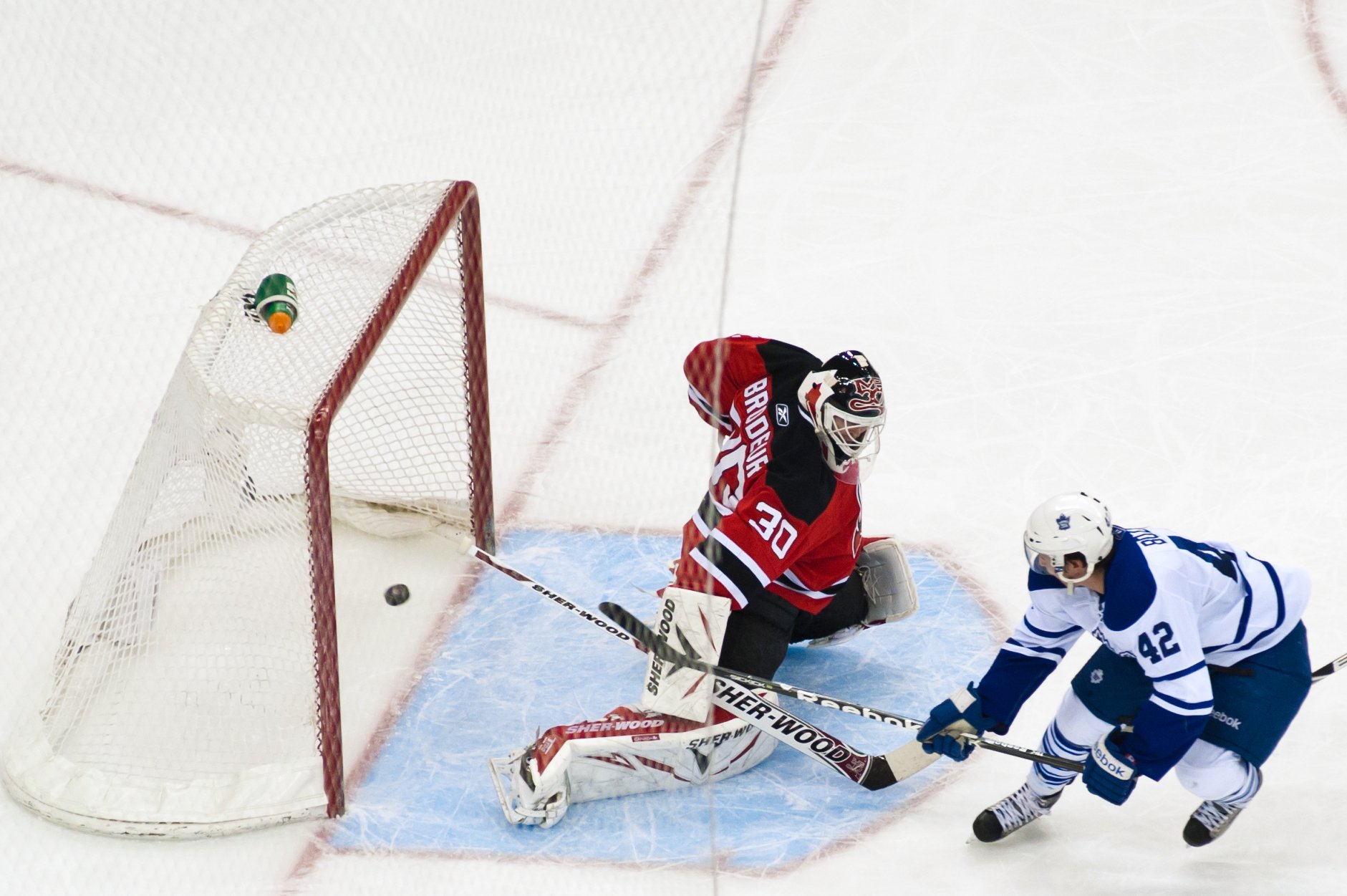
Photo: James DiBianco, Wikimedia Commons (BY-SA-2.0)
Jack Roslovic Has Won the Maple Leafs' Top-Line Right Wing, and It Isn't Close
Table of Contents
Jack Roslovic answered the Maple Leafs' loudest camp question in one night
Jack Roslovic put up three points in Toronto's 6-1 preseason finale against Ottawa on Wednesday, including a power-play goal, and in doing so ended an argument that had been running since the first day of training camp. The top-line right wing job beside Auston Matthews is his. Not provisionally. Not until somebody better shows up. His.
We are going to make the stronger version of that claim: not only has Roslovic won the spot, the alternatives were never as good as the debate implied, and the club is better off for having resolved it in September rather than dragging a rotating cast through October.
That is an opinion. Here is the scaffolding under it.
The competition was thinner than it looked
When camp opened, the top-line right wing conversation included Roslovic, a McKenna-up-the-lineup scenario, and a handful of bottom-six bodies being aspirationally promoted in projection pieces. We argued at the time that the whole framing was built backwards — that the question was not who deserves to play with Matthews, but what kind of winger makes Matthews better.
Those are different questions with different answers. Matthews does not need a puck carrier. He is the puck carrier. What he has historically needed is a winger who can get open in the low slot, retrieve pucks on the half wall so the line does not have to re-enter, and finish a pass without requiring three touches.
Roslovic is a shooter with soft hands in tight and enough straight-line pace to stay in the picture on a Matthews rush. That is an unglamorous description and it is exactly the profile.
Why the McKenna option was always wrong
Putting the No. 1 overall pick on Matthews' wing was the fun answer, and it would have been a mistake. An 18-year-old in his first professional month needs the version of hockey where his linemates cover for his reads, not the version where he is the third man on the hardest matchup in the Atlantic every night.
Hiller has had McKenna at left wing with John Tavares and William Nylander since the opening days of camp, and that alignment has not moved once. It is the correct call — a sheltered-but-real assignment with two veterans who will talk him through it. He picked up his first preseason point on exactly that line in the finale.
What Roslovic actually did on Wednesday
Three points, one of them a power-play goal in the second period. The power-play conversion is the piece that deserves the most weight, because Toronto's man advantage has been rebuilt from the retrieval game outward this camp and the club needs a second net-front threat who is not Matthews.
More important than the counting stats: he was not a passenger. Hiller said before the game that he wanted more from the Matthews line specifically, which was a coach publicly putting a unit on notice in the last tune-up. That line then produced multiple goals. Whatever the message was, it was received.
Pre-season points are close to meaningless in isolation. Pre-season points from a player whose specific job was under review, in the game his coach flagged in advance, against a division opponent, with the lineup card the coach intends to dress five days later — that is not isolation. That is a final exam.
The cheap objection, addressed
The obvious pushback: Roslovic has bounced through five organizations, has never been a fixture in a top-six role for a good team, and has a career pattern of productive stretches followed by disappearing acts. All of that is true, and none of it is an argument for somebody else.
Toronto is not asking him to be a first-line winger in the abstract. It is asking him to be the third-best player on a line where Matthews drives play and Matthew Knies does the heavy work below the goal line. That is a role that flatters exactly the kind of player Roslovic is — a finisher with real hands who is not asked to create the chance he finishes.
The failure mode is not that he is bad. It is that he gets cold for six weeks in January and the coaching staff has no alternative, because the alternative is a rookie who should not be there. That is a legitimate risk. It is also a mid-season problem, not a September one, and it is solvable at the trade deadline with cap space the club will have once the Max Domi long-term injured reserve mechanism is in place.
The case from how Matthews actually scores
Look at where Matthews' goals come from and the winger requirement writes itself. He shoots from the left circle off the rush, he shoots off the half wall on the power play, and he converts in tight when a puck arrives below the dots. Almost none of that requires a right winger who carries the puck through the neutral zone.
What it does require is a right winger who does three things reliably. First, hold the offensive blue line so a dump-in becomes a possession instead of a change. Second, get to the net-front on the power play and make a goaltender track through a body. Third, be somewhere useful when Matthews draws two defenders, which he does on most shifts.
Roslovic can do all three. He is not elite at any of them. He does not need to be, because the line's job is not to be balanced — it is to get its centre the puck in the places where he is the best finisher in the sport.
The alternative nobody wants to say out loud
The other honest option was William Nylander, and Toronto is not doing it. Splitting Nylander from Tavares would upgrade the first line and gut the second, which is the oldest trade-off in hockey roster construction and one this organization has run enough times to know the answer to. Keeping two lines dangerous beats making one line unstoppable, particularly for a club whose 2025-26 problem was scoring depth rather than star production.
That constraint is why the right wing competition mattered at all. If Nylander were available for the spot, Roslovic would be a third-line winger and this would not be a story.
What this does to the rest of the lineup
Settling the right wing has a cascading benefit that gets underrated. It means Knies stays on the left with Matthews rather than being shuffled up and down as a plug. It means Nylander stays with Tavares, where he has been productive and where he can shelter McKenna. It means the third line built around Nick Paul and Colton Sissons keeps its identity as a checking unit rather than being raided every time the top six needs a body.
A settled top nine in September is worth more than the marginal upgrade of continuing to audition. Line chemistry is real and it is slow to build. Toronto spent the last two seasons blending and re-blending its forward group in response to slumps, and it did not work either time.
What we would still like to see
Roslovic's defensive results have historically been poor, and the Matthews line will take hard matchups. If the first ten games show that unit getting caved in on expected goals against, the answer is not to swap the winger — it is to give Hiller permission to shelter the line the way good coaches shelter scoring units, and let the Paul-Sissons group eat the difficult starts. That is what those players were signed to do.
What's next
Montreal, Sept. 29, 7 p.m. ET at Scotiabank Arena, with a Canadiens team that added Chris Kreider to an already-locked-in core. Roslovic will draw Nick Suzuki's line for a good chunk of the night. It is a real test on night one.
Our position is that he passes it, and that six months from now the right-wing debate reads like the non-story it probably always was. Track the lineup on our players page and where it all lands on standings.
Frequently Asked Questions
Who plays right wing on Auston Matthews' line for the Maple Leafs?
Jack Roslovic. He is projected to start the 2026-27 season on the top line with Matthews at centre and Matthew Knies on the left wing, after posting three points including a power-play goal in the Sept. 23 preseason finale against Ottawa.
How did Jack Roslovic play in the Maple Leafs preseason?
He capped it with a three-point night in the 6-1 win over Ottawa on Sept. 23, 2026, including a second-period power-play goal. Jim Hiller had publicly said before that game that he wanted more from the Matthews line, and the unit delivered.
Why isn't Gavin McKenna playing on Auston Matthews' line?
Hiller has kept McKenna at left wing with John Tavares and William Nylander since the opening days of camp. It is a sheltered assignment with two veterans rather than the hardest matchup in the division, which is the appropriate deployment for an 18-year-old in his first NHL month.
Why is Jack Roslovic considered a risky top-six option?
He has moved between several organizations over his career and has a pattern of productive stretches followed by extended cold spells, without ever being a season-long fixture in a top-six role on a contending team. The counterargument is that Toronto is asking him to finish chances rather than create them.
What is the Maple Leafs' projected forward group for 2026-27?
The projected top nine has Matthews between Knies and Roslovic, Tavares centring McKenna and Nylander, and a third line built around offseason additions Nick Paul and Colton Sissons. The fourth line and 13th forward spot were still being settled in the final days of camp.
When is the Maple Leafs home opener in 2026?
Tuesday, Sept. 29, 2026 at 7 p.m. ET against the Montreal Canadiens at Scotiabank Arena, broadcast on Sportsnet. It is the seventh consecutive season the two clubs have met in the opener.
Did the Maple Leafs change their power play for 2026-27?
Yes. The new coaching staff rebuilt the man advantage around zone retrievals and faceoff wins rather than relying on clean entries. Roslovic's power-play goal in the preseason finale was an early sign of a second net-front threat emerging alongside Matthews.