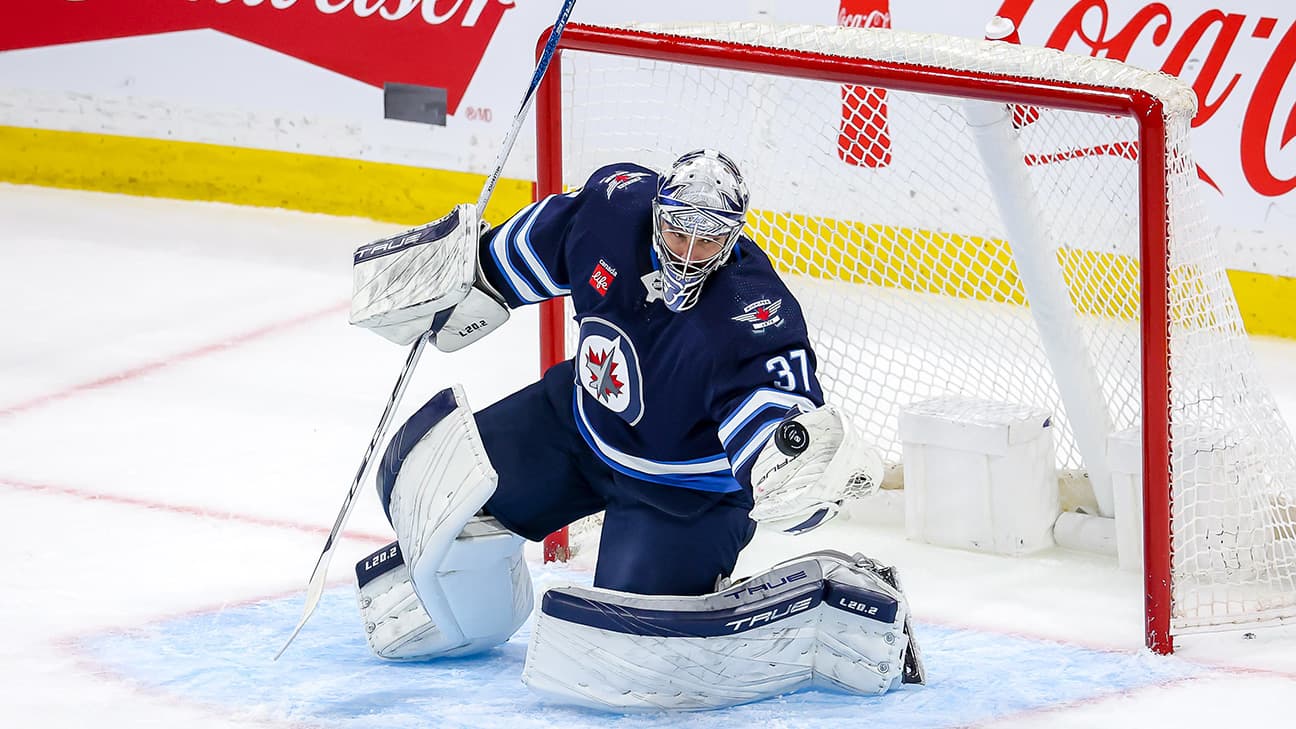
Photo: NHL.com
Hellebuyck Trade to an Atlantic Rival Is the Maple Leafs' Real Risk
Table of Contents
A Hellebuyck trade inside the Atlantic Division is the outcome that actually hurts Toronto
The wrong question about the Connor Hellebuyck trade request is whether the Maple Leafs should get involved. They can't, and we laid out why in detail. The right question is a Hellebuyck trade to an Atlantic Division rival — because three of the destinations being floated for the best goaltender of his generation are teams Toronto has to climb over to make the playoffs.
Buffalo. Detroit. Ottawa. Each has been named in Hellebuyck speculation since his agent went public on Thursday. Each plays the Maple Leafs four times this season under the new 84-game divisional format. And each currently has a crease that ranges from unsettled to actively bad.
Toronto finished eighth in the eight-team Atlantic last season at 32-36-14, 78 points. Anything that raises the floor of the teams directly above them is a direct cost to the Leafs' 2026-27, and an elite goaltender is the single most efficient way to raise a team's floor in this league.
What Toronto is actually climbing
The Leafs went from 52-26-4 and 108 points to 78 points in one season — a 30-point collapse, a franchise record for a single-year decline. That is the hole John Chayka inherited and has spent the summer trying to fill with six new forwards, a new goaltender, a new coach and the first overall pick.
Even a good version of that plan probably gets Toronto to 90-95 points. In this division, 90-95 points is not a guaranteed playoff spot. Florida and Tampa Bay are not going anywhere. Ottawa has been rising. Detroit has been trying to break through for the better part of a decade and finally has real forward talent. Montreal is ahead of schedule. Boston is Boston.
The margin between third in the Atlantic and out of the playoffs is going to be small. Which is why a rival adding a goaltender who has won three Vezina Trophies and a Hart is not an abstract concern. It is worth points in the standings, directly, in games Toronto has to win.
Buffalo is the destination with actual reporting behind it
Sportsnet's Elliotte Friedman has described direct Sabres-Jets conversations dating back to the June draft, and has indicated Hellebuyck would be open to waiving his no-movement clause for Buffalo specifically. A framework built around Ukko-Pekka Luukkonen heading to Winnipeg has been discussed publicly. Neither club has confirmed anything, and until a deal is announced this remains reporting rather than fact.
But consider what it would mean. Luukkonen has posted a pair of .910 save-percentage seasons — respectable, not close to elite. Swapping him for Hellebuyck, even a Hellebuyck coming off a .895, is the largest single-position upgrade available in the NHL this summer. Buffalo's problem has never been talent up front. It has been that the Sabres give up goals in bunches and cannot steal a game.
A Buffalo team that can steal games is a Buffalo team that finishes ahead of Toronto. That is not a hot take, it is arithmetic.
Ottawa is the version that should genuinely worry you
The Senators' goaltending situation is the worst in the division and it is not close. Linus Ullmark, a Vezina winner in Boston, has not been the same since arriving in Ottawa, and last season was the worst of his career: a 2.73 goals-against average and an .891 save percentage. Behind him, Leevi Merilainen struggled badly in 20 games, and Samuel Ersson — who Toronto briefly owned as part of the Joseph Woll trade in June before flipping him — is not the answer either.
Ottawa is a team with a good young core, a real defence, and a hole in the one position that decides close games. That is the exact profile of a club that talks itself into paying a premium for a franchise goaltender. Whether they have the assets Winnipeg wants is a different question, and whether Hellebuyck would waive for Ottawa is unknown.
But if it happened, the Senators would go from a team Toronto can beat to a team Toronto probably cannot. That is the swing.
Detroit already made its move
The Red Wings are set to open with John Gibson and Daniil Tarasov, which reads as a bet that Gibson's late-career resurgence is real. It is a reasonable bet and it is also the kind of tandem a team upgrades from the second something better becomes available.
Detroit has been the Atlantic's perpetual almost for years. The forward group is legitimate. The blue line has been the problem, and goaltending has papered over it inconsistently. Steve Yzerman has been famously patient with his assets — which cuts both ways here. He has the picks and prospects to win a Hellebuyck bidding war. He has also never shown much interest in paying a premium at that position.
Call Detroit the least likely of the three, but not zero.
Where Toronto's crease sits in that picture
Here is the uncomfortable part. Toronto's own goaltending is a question mark, not a strength. Sergei Bobrovsky is 38 in September and coming off a reported .877 in Florida. Anthony Stolarz has been excellent in stretches and has never carried a full starter's workload for a season. We went through the whole thing in our breakdown of the Bobrovsky-or-Stolarz question, and the honest conclusion was that Toronto has two goaltenders with real upside and real risk.
Now imagine that tandem finishing seventh in the division in save percentage while Buffalo or Ottawa is running out a three-time Vezina winner. Toronto's margin for error in the run-and-gun games that define this division would be effectively gone.
That is the scenario. Not "the Leafs missed out on Hellebuyck." The scenario is "the Leafs missed out on Hellebuyck and a team they need to beat did not."
What Chayka can actually do about it
Nothing, directly. Toronto is roughly $2.75 million over the $104 million cap ceiling and has $10.75 million committed to two goaltenders. There is no trade here, and there is no blocking move — you cannot outbid someone for a player whose no-movement clause means he picks the team anyway.
What Chayka can do is what he has been doing: keep building a roster that does not need elite goaltending to win. That means the forward depth he added in July, it means finishing at even strength, and it means the difference-maker trade conversation staying alive into the season. A team that scores four goals a night is less exposed to the goaltending gap than a team that scores two and a half.
It also means Bobrovsky has to be good. Not adequate — good. Toronto's July 1 bet is going to be judged against whatever Hellebuyck does in whichever sweater he ends up wearing, and if that sweater is a division rival's, the comparison will be made every single week on Toronto radio.
What's next
Winnipeg is under no pressure to move fast. Kevin Cheveldayoff has roughly $21.6 million in cap space and a roster that should be better than last season's, and he can comfortably open camp with Hellebuyck in the room and revisit at the deadline. A public trade request creates noise, not a deadline.
So this may sit unresolved past Sept. 16, past opening night, into December. That is fine for the Jets. It is less fine for Leafs fans who would like to know by October whether the Atlantic just got a new best goaltender.
Keep an eye on the division standings once games start. If Buffalo or Ottawa is hanging around .500 in November with mediocre goaltending, they become the aggressive buyer — and Toronto's already difficult road back gets a lot steeper.
Frequently Asked Questions
Which Atlantic Division teams could trade for Connor Hellebuyck?
Buffalo, Ottawa and Detroit have all been raised in speculation since Hellebuyck's trade request became public on Aug. 27, 2026. Buffalo is the only one with substantive reporting behind it, with Sportsnet's Elliotte Friedman describing Sabres-Jets conversations dating to the June draft.
Where did the Maple Leafs finish in the Atlantic Division last season?
Toronto finished eighth and last in the eight-team Atlantic in 2025-26, going 32-36-14 for 78 points. That was a 30-point drop from the 52-26-4, 108-point season before it — a franchise record single-season decline.
How many times do the Maple Leafs play divisional opponents in 2026-27?
Four times each. The NHL's new 84-game schedule, which begins with the 2026-27 season, adds two games per team and gives every club four games against each divisional rival.
How bad was Ottawa's goaltending in 2025-26?
Linus Ullmark posted the worst season of his career with a 2.73 goals-against average and an .891 save percentage. Backup Leevi Merilainen struggled badly in 20 games with a .860 save percentage and a 3.51 GAA.
Who are the Maple Leafs' goalies for 2026-27?
Sergei Bobrovsky, signed to a three-year, $21 million contract on July 1, 2026, and Anthony Stolarz, signed through 2029-30 at $3.75 million per season. That is $10.75 million committed to the crease against a $104 million cap.
Can Winnipeg trade Hellebuyck anywhere it wants?
No. Hellebuyck holds a full no-movement clause for the 2026-27 season, so he controls his destination entirely. It becomes a modified no-trade clause with a 10-team list in 2027-28.
Do the Jets have to trade Hellebuyck before the season?
No. Kevin Cheveldayoff has roughly $21.6 million in cap space and can open training camp with Hellebuyck on the roster. A public trade request creates media pressure but no contractual deadline, so a deadline-day resolution is realistic.


