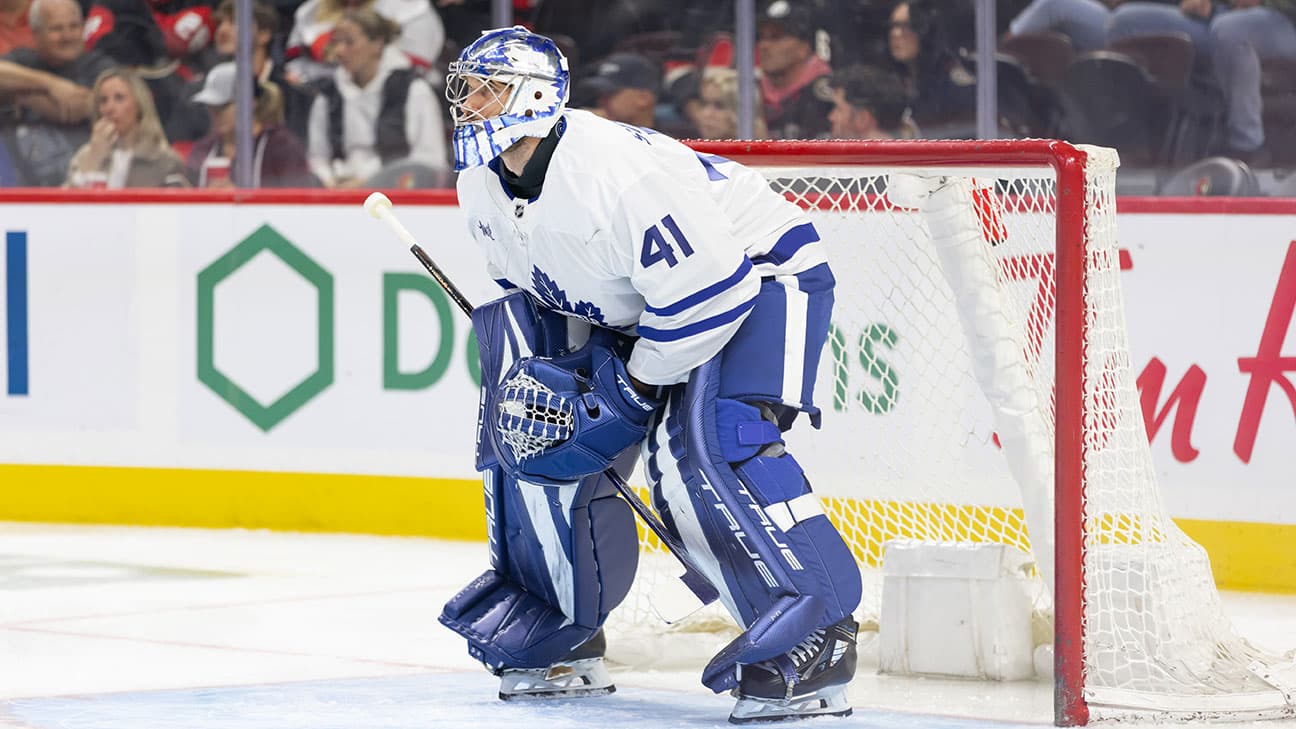
Photo: NHL.com
Maple Leafs Starting Goalie 2026-27: Bobrovsky or Stolarz?
Table of Contents
The Maple Leafs starting goalie question is not settled, and pretending otherwise is a mistake
The Maple Leafs starting goalie job for 2026-27 belongs to Sergei Bobrovsky on paper and to nobody in practice. Toronto signed Bobrovsky to a three-year, $21 million contract on July 1 — a $7 million cap hit for a goaltender who turns 38 in September and is coming off the worst full season of his career. Anthony Stolarz is signed for four more years at $3.75 million and was, two seasons ago, the best save-percentage goaltender in the National Hockey League.
Both of those sentences are true and they point in opposite directions. That is the whole story of Toronto's crease heading into Jim Hiller's first training camp.
John Chayka did not build a tandem. He built a competition and then paid one side of it like a starter.
What Bobrovsky actually did last season
The résumé is enormous: two Vezina Trophies, two Stanley Cups with Florida, a decade and a half of being the guy. The 2025-26 season was not that. Bobrovsky went 27-23-1 in 52 games with a 3.07 goals-against average and a reported .877 save percentage.
An .877 from a starting goaltender is not a slump. It is a number that gets goaltenders replaced. Florida did not blame him for the whole of a disappointing season, and there is a reasonable argument that the team in front of him had cracked, but the raw figure is what it is. Toronto paid $7 million a year, on a three-year term, for a 37-year-old coming off that.
The bet is legible. Bobrovsky has rebounded before, most notably in the two runs that ended with him lifting a Cup. Behind a structured defensive team he has been the difference in exactly the situations Toronto has failed in. Chayka is buying the version of Bobrovsky that shows up in April, and accepting the risk that it no longer exists.
Stolarz is the more interesting variable
Stolarz's 2025-26 was a mess for reasons that had little to do with how he stops pucks. He played 26 games, went 10-10-3 with a 3.28 goals-against average and an .893 save percentage, and spent the rest of the year hurt — an upper-body issue, then a groin strain that ended his season. He avoided offseason surgery.
Rewind one year and the picture inverts completely. In 2024-25, Stolarz led the entire NHL with a .926 save percentage and finished third in goals-against average at 2.14. That is not a small sample fluke dressed up as a season; that is the best goaltending Toronto has had in a very long time.
The honest read is that Toronto has one goaltender who has been elite and cannot stay healthy, and one who has been elite and is now 37. Signing both is defensible. Deciding in August which one starts in April is not.
Why the depth chart is genuinely unresolved
NHL.com's team reset described Bobrovsky as stepping in as Toronto's No. 1, and the money supports it. But reporting on the pecking order has not been consistent, and there is a reason for that: Hiller has never coached either of these goaltenders, and no coach commits to a starter before he has seen a camp.
The workload question is the practical one. Bobrovsky at 38 should not be playing 55-plus games, and the NHL's move to an 84-game schedule makes the arithmetic worse rather than better — something we examined in our look at what two extra games do to an aging roster. A 46-38 split is the sane version. A 58-26 split is the version that gets a 38-year-old to March with nothing left.
Toronto also gutted the organizational depth behind them. Joseph Woll was traded to Philadelphia on June 16 and Dennis Hildeby was moved as well, which is how the Bobrovsky signing became necessary in the first place. That leaves a thin third-string picture that we covered when we looked at Toronto's options for a camp goaltender on a tryout. If either of the top two misses six weeks, the depth chart gets uncomfortable fast.
There is no help coming from the pipeline
The uncomfortable truth behind the tandem debate is that Toronto has no internal answer if this goes badly. Trading Woll and Hildeby in the same offseason emptied the tier of goaltender who can be recalled in December and hold the fort for a month.
The prospect cupboard is not bare, but it is years away. Patriks Plūminš, taken 114th overall in June, is an 18-year-old out of Latvia who posted a .947 save percentage and a 1.62 goals-against average across five games at the U18 World Championship and a .927 with Zemgale in the Latvian league. At six-foot-four with genuine tracking ability, he is a legitimate draft-and-develop asset. He is also not going to play an NHL game before the 2030s.
That leaves the Marlies crease and a professional tryout as the only realistic sources of a third body, and it puts unusual weight on Bobrovsky and Stolarz simply being available. A team pressed against the cap with two goaltenders and no third option is running a risk it has chosen not to price.
The Stolarz trade chatter, and why it is mostly noise
A handful of outlets have floated Florida as a landing spot for Stolarz, on the logic that the Panthers lost Bobrovsky and Stolarz was Bobrovsky's backup during Florida's 2024 championship run. It is a tidy narrative. It is also speculation from outside the building, not reporting from inside it, and it should be labelled as such.
The case against it is simple. Stolarz at $3.75 million is one of the better value contracts on Toronto's books, and value contracts are exactly what a team pressed against a $104 million ceiling needs. He is also the insurance policy on a $7 million bet with real age risk attached. You do not sell your insurance in the same summer you buy the risk.
Trading Stolarz would only make sense as part of a larger move — a package for a top-six forward, say — and even then Chayka would be creating a hole he has no cheap way to fill. We ran through what a real difference-maker trade would actually cost this roster, and the goaltending is the one area where the current group is genuinely deep enough to matter.
What good looks like
Set the bar honestly. Toronto does not need Vezina goaltending to make the playoffs out of a hard Atlantic. It needs league-average or better across a full 84-game schedule and a goaltender who is upright and playing well in April.
That means the target is not "who starts opening night." It is a combined save percentage in the .905 range with neither goaltender crossing 50 starts, and it means Hiller has to be willing to ride the hot hand in February rather than protecting a contract. Chayka has shown he is comfortable with uncomfortable decisions. Whether Hiller is, in his first year in the most scrutinized job in the sport, is a different question.
The failure modes are easy to name. Bobrovsky plays 58 games because he is the expensive one, wears down, and Toronto goes into the spring with a tired 38-year-old. Or Stolarz gets hurt again in November and the whole plan rests on one man. Both are plausible. Neither requires anyone to play badly.
What's next
Camp opens in September and the first meaningful signal is preseason usage: who gets the split-squad throwaways and who gets the last dress rehearsal. The Leafs open September 29 at home to Montreal, and whoever gets that start will be read as the answer whether or not it is one.
Watch for a third goaltender arriving on a professional tryout before camp — that is the cheapest fix available and the one most likely to happen quietly. And watch Bobrovsky's workload in October. If he is starting five of the first six, Toronto has already made a decision it should be making in March instead.
For the cap picture behind all of this, our contracts page tracks where the $104 million goes, and the compliance breakdown explains why there is no room to add in net if this goes wrong.
Frequently Asked Questions
Who is the Maple Leafs starting goalie for 2026-27?
It is not formally settled. Sergei Bobrovsky signed a three-year, $21 million contract on July 1, 2026 and has been described as Toronto's No. 1, but Anthony Stolarz is signed through 2029-30 and led the NHL in save percentage in 2024-25. Jim Hiller has coached neither goaltender and the order should be decided in training camp.
What is Sergei Bobrovsky's contract with the Maple Leafs?
Three years and $21 million total, a $7 million average annual value, signed on July 1, 2026. The deal runs through the 2028-29 season, after which he becomes an unrestricted free agent.
How did Sergei Bobrovsky play in 2025-26?
Poorly by his standards. Bobrovsky went 27-23-1 in 52 games with Florida, posting a 3.07 goals-against average and a reported .877 save percentage. It was a significant decline from the form that produced two Stanley Cups and two Vezina Trophies.
What is Anthony Stolarz's contract?
Stolarz signed a four-year extension with Toronto worth $15 million, a $3.75 million average annual value, finalized in late September 2025. It runs through the 2029-30 season and is one of the better value contracts on the Leafs' books.
How good was Anthony Stolarz in 2024-25?
He led the entire NHL with a .926 save percentage and finished third in goals-against average at 2.14. His follow-up season was derailed by injury: 26 games, a 10-10-3 record, a 3.28 goals-against average and an .893 save percentage.
Why did the Maple Leafs need a goalie in 2026 free agency?
Toronto traded Joseph Woll to Philadelphia on June 16, 2026 and also moved Dennis Hildeby, clearing out its goaltending depth behind Stolarz. Signing Bobrovsky on July 1 filled the resulting hole in the NHL crease.
Are the Maple Leafs trading Anthony Stolarz to Florida?
There is no reporting that they are. Several outlets have speculated about a Panthers reunion because Stolarz backed up Bobrovsky during Florida's 2024 Cup run, but that is outside speculation rather than reported trade talks. His $3.75 million cap hit is valuable to a team already pressed against the ceiling.
How many games should Sergei Bobrovsky play at 38?
A split closer to 46-38 makes more sense than a traditional starter's workload. Bobrovsky turns 38 in September 2026, and the NHL's expanded 84-game schedule adds to the load, which makes protecting him through the winter more important than establishing a clear No. 1 in October.


