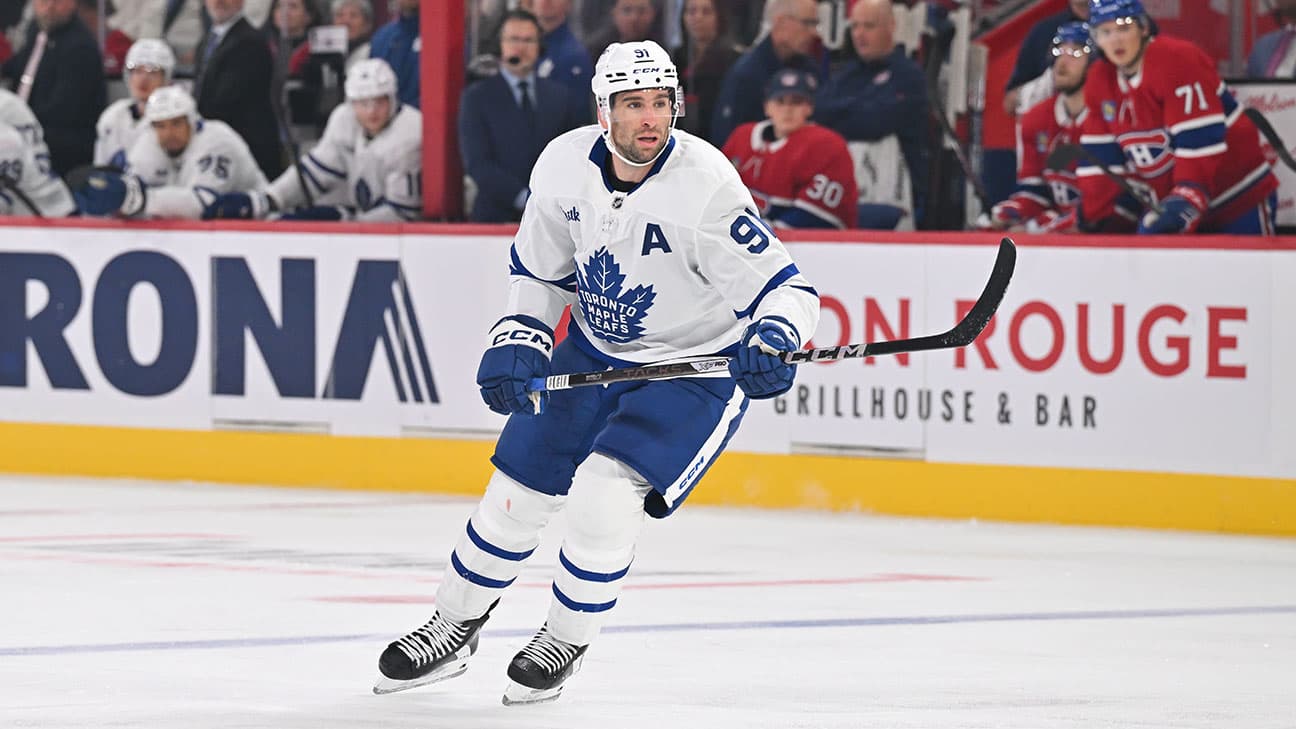
Photo: NHL.com
Gavin McKenna Power Play: Keep Him on PP1 When Tavares Returns
Table of Contents
The Gavin McKenna power play call is coming
Gavin McKenna moved up to the Maple Leafs' first power-play unit in Toronto's 6-3 win at Colorado on Oct. 10, and set up William Nylander's power-play goal with a seam pass through the Avalanche penalty kill. He got the spot because John Tavares was home after the birth of his son. When Tavares comes back, Jim Hiller has a Gavin McKenna power play decision to make, and LeafsLurker's position is simple: keep the 18-year-old on PP1.
This is not a knock on Tavares. It is a judgment about where each player helps most in 2026-27, on a team that has already changed most of its top-unit personnel from last season and needs its power play to win games it does not control at five-on-five.
What Hiller said, and what he did not
Hiller was clear after the game that the rookie's role was not a gift. "We're not just giving that to him. He's earned that," he said, per Maple Leafs Hot Stove. "He's just a good player, and he's going to be for a long time." He also hedged, saying that the time on the top unit does not mean McKenna will start there every night, but that when he is playing well, he is going to get those shifts.
That is a coach keeping his options open, and fair enough. But the hedge leaves room for the most common outcome in hockey: the veteran returns, the lines go back to the way they were in September, and the rookie's promotion becomes a footnote. Hiller should resist that pull.
Auston Matthews, for his part, called McKenna elite after the game and praised his hockey sense, saying the rookie sees plays before they develop. Captains do not usually say that about teenagers to fill a postgame scrum.
McKenna's start in numbers
Through six games, McKenna has one goal and three assists and is averaging 14:39 of ice time. All four points have come in his last three games, and his game has visibly grown since Hiller moved him off the second line, which we argued was the right call in our piece on McKenna's third-line move.
DateOpponentMcKenna's pointsNoteOct. 6NashvilleGoal and assistFirst NHL goal and point, 5-4 overtime winOct. 8at VegasAssist4-3 shootout loss, first game on the third lineOct. 10at ColoradoPower-play assistOn PP1 with Tavares out, set up NylanderFour points in six games does not make anyone a star. What matters is the type of play. The assist in Denver was a seam pass across the penalty kill to Nylander's stick in a scoring area, the kind of play that breaks a box structure. That is a power-play skill, and it is the one McKenna has more of than anyone else on the roster except Nylander and Matthews.
Why the old top unit is not the template
The instinct to go back to a familiar first unit makes sense only if the familiar version worked. It did not, at least not last season. Toronto's power play fell to 21.3 per cent in 2025-26, down from 24.8 per cent in 2024-25 and 23.9 per cent the year before. The most-used five-man group of Tavares, Morgan Rielly, Nylander, Matthews and Matthew Knies ranked 26th in the league in first-unit goals per game, according to the PowerPlayUnits tracker.
That unit is gone in any case. Knies was traded to Columbus on Sept. 29 in the deal that brought Kirill Marchenko to Toronto, which we covered in our Marchenko trade breakdown. Marchenko has already scored on the power play, on Oct. 6 against Nashville. Darren Raddysh, signed through 2033-34 at $8.5 million a year, gives the top unit a right-shot point man who can shoot. The pieces have changed. The power play should change with them.
Where Tavares fits instead
Tavares' power-play value is real. He wins faceoffs, he plays the bumper and the net front, and he has scored a lot of his goals within a few feet of the crease. But the Leafs do not need him in the same role on the top unit to get that value. There are better ways to use him.
- Make him the anchor of PP2. A second unit with Tavares in the middle, Marchenko or Easton Cowan on a flank and Rielly at the point is a credible group that would get real minutes, not leftover seconds.
- Use him for the faceoff, then change. Hiller can start Tavares on the ice for offensive-zone draws on the power play and swap him for McKenna after possession. Coaches do this with centres all the time.
- Keep him on PP1 in a different seat. If Hiller insists on Tavares at the net front, the player to move is not McKenna. A four-forward unit of McKenna, Matthews, Nylander and Tavares with Raddysh at the point is more dangerous than any version without the rookie.
Tavares is 36, he is on a $4.38-million deal with a no-move clause through June 30, 2027, according to the LeafsLurker contracts page, and he has been a model professional through every role change in Toronto. He will understand this one too.
The risk, and why it is worth taking
The honest case against is that McKenna is 18, has played six NHL games and has not yet faced a stretch where teams game-plan for him. The power play is where veteran penalty-killers set traps for players who force passes, and a rookie on the top unit will give the puck away. Some nights, that will cost Toronto a short-handed chance or a goal.
The trade-off is still clearly worth it. A power play that only works when it is safe was 26th in first-unit scoring last year. The Leafs need one that can break a structured penalty kill, and McKenna's passing is the tool for that. Hiller has already built his even-strength usage to protect McKenna by surrounding him with responsible veterans. The power play is the one place where the rookie does not need protection, because the risk of a turnover is lower and the reward of a goal is immediate.
There is also a development argument. The first overall pick's long-term value to this franchise is as a top-of-the-lineup offensive player. The best way to grow that player is to give him real minutes in the situations he will dominate later. Power-play reps against NHL penalty-kills cannot be simulated in practice.
What's next
Toronto plays at Utah on Oct. 13, then hosts Buffalo on Oct. 15 and the Islanders on Oct. 17. It was not confirmed as of Monday whether Tavares will rejoin the team for the Utah game. When he does, the first power-play unit Hiller sends out will say a lot about how he plans to use the first overall pick this season.
Hiller said it himself: McKenna has earned it. The right call is to keep giving him what he has earned, and let him show whether he can hold the job against the league's best penalty kills. Our guess is that he can. You can follow how the rest of the roster is being used on our players page.
Frequently Asked Questions
Is Gavin McKenna on the Maple Leafs' first power play?
McKenna played on the first power-play unit on Oct. 10, 2026, in a 6-3 win at Colorado while John Tavares was away after the birth of his son. He assisted on William Nylander's power-play goal. Coach Jim Hiller said he earned the time but would not commit to him starting there every night.
How many points does Gavin McKenna have?
Through six games of the 2026-27 season, McKenna has one goal and three assists for four points and averages 14:39 of ice time. All four points came during a three-game point streak from Oct. 6 to Oct. 10.
What did Jim Hiller say about Gavin McKenna?
After the Oct. 10 win in Colorado, Hiller said, "We're not just giving that to him. He's earned that," and called McKenna a good player who will be for a long time, per Maple Leafs Hot Stove. He added that McKenna's power-play time depends on how well he is playing on a given night.
What was the Maple Leafs' power play percentage last season?
Toronto's power play converted 21.3 per cent of its chances in 2025-26, down from 24.8 per cent in 2024-25 and 23.9 per cent in 2023-24. Its most-used top unit ranked 26th in the league in first-unit goals per game, according to the PowerPlayUnits tracker.
Why did John Tavares miss the Avalanche game?
Tavares and his wife, Aryn, welcomed their fourth child, a son named Tucker, on Oct. 9, 2026. Tavares missed the Oct. 10 game at Colorado, and his return date had not been confirmed as of Oct. 12.
When was Gavin McKenna drafted?
The Toronto Maple Leafs selected Gavin McKenna first overall in the 2026 NHL Draft. He is 18 and on an entry-level contract with a $1.075-million cap hit that runs through 2028-29.

