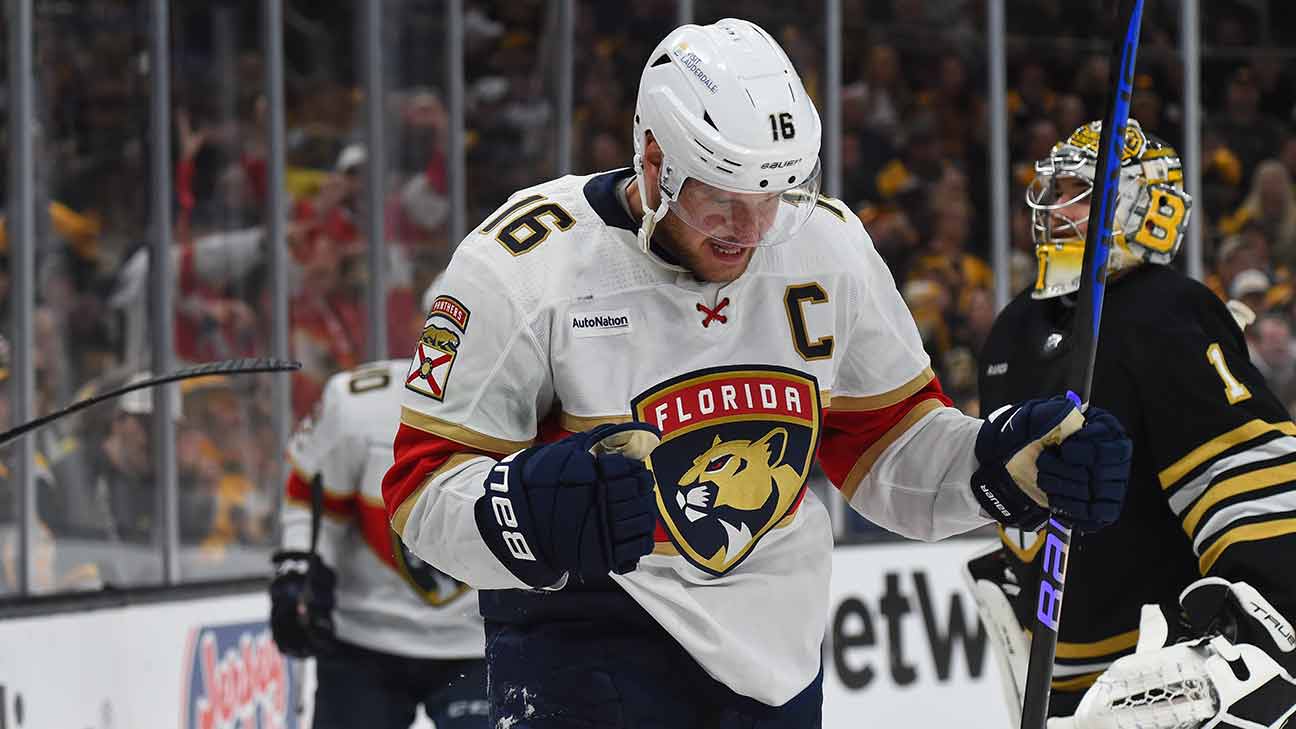
Photo: NHL.com
Aleksander Barkov Is Back, and the Atlantic Just Got Harder
Table of Contents
The Aleksander Barkov return is officially on. Florida's captain told reporters at the NHL's player media tour this week that his surgically repaired right knee is no longer a concern, which puts the best two-way centre of his generation back in the Atlantic Division after a full season away. For a Maple Leafs team trying to climb out of seventh place, that is the single most consequential piece of news anybody delivered in Las Vegas.
Barkov tore the ACL and MCL in his right knee on the first day of Florida's 2025-26 training camp and had surgery the following day. He missed all 82 games. The Panthers, who had won the Stanley Cup in 2024 and 2025, finished seventh in the Atlantic at 40-38-4 and missed the playoffs.
That team is getting its captain back. Toronto's path to the postseason was drawn on the assumption that Florida stayed broken.
What the Aleksander Barkov return is actually built on
The important part was not the optimism. Every player says he feels great in September. The important part was that Barkov already has a real test behind him.
Cleared in time for the 2026 IIHF World Championship in Switzerland, he played for Finland in May and led his country in scoring with three goals and 11 points in 10 games. That is not a cameo. That is a full tournament against NHL-calibre opposition, eight months after a double-ligament reconstruction.
"That was the main worry, that if I will be able to play free and not to think too much," Barkov said of the Worlds. "And once the first game started, I wasn't thinking about it at all."
Knee reconstructions do not typically take skating away permanently. What they take away, for a year or more, is the confidence to plant and turn without thinking. Barkov is saying that part is finished. If he is right, Florida is getting the real thing back, not a diminished version.
What Florida actually lost without him
The Panthers' collapse last season gets framed as an injury story, and it was — Florida lost 541 man-games and did not have a single player appear in all 82 games. But Barkov's absence was categorically different from the rest of it.
He is a Selke Trophy winner and perennial finalist who also produces at close to a point per game. He takes the opposing team's best line every night, wins faceoffs, kills penalties and drives play. When you remove a player like that, you do not lose a slot in the lineup. You lose the structure that lets everyone else play the role they are good at.
Florida's forward group spent last season with everyone playing a rung above their level, which is precisely what Toronto's blue line would look like if Chris Tanev's clearance does not come through — a problem we detailed in this week's Tanev update. The mechanism is identical, just at a different position and a much higher price.
Becoming the first defending champion to miss the playoffs since the 2014-15 Los Angeles Kings, and the first two-time defending champion to miss since the 1969-70 Canadiens, is the kind of statistic that sounds like a franchise unravelling. It was mostly one knee and a training staff working overtime.
The Atlantic math for Toronto
Here is the uncomfortable version for Leafs fans.
Last season, two of the Atlantic's traditional powers were down at once. Toronto missed the playoffs and won the draft lottery. Florida missed the playoffs and lost more man-games than almost any team in recent memory. Those two things happening in the same year is why the division looked winnable in July.
Both teams are healthier now, but they are not healthier in the same way. Toronto's improvement is theoretical: a new coach in Jim Hiller, a new system, nine new free agents, an 18-year-old first overall pick and a 38-year-old goaltender. Florida's improvement is a Hall-of-Fame-track centre walking back into a lineup that already knows how to win.
Most preseason projections have Toronto fourth in the Atlantic, and we argued in our season prediction piece that fourth is generous. Barkov's return makes it more generous still. The wild-card math in the East is brutal, and every point Florida takes back is a point that comes out of somebody's pocket.
Florida is not fully whole
There is a counterweight, and it is worth stating honestly rather than wishing it bigger than it is.
Brad Marchand's start to the season is in doubt following surgery, a situation we covered here. Florida also lost Sergei Bobrovsky to Toronto in free agency on July 1, a three-year, $21 million deal that reshaped both teams' crease situations at once. A Panthers roster without its starting goaltender of the championship years is a genuinely different team, and the goaltending question in Sunrise is real.
So the correct read is not "Florida is back to 2025 form." It is "Florida's floor just rose by a lot." A team with Barkov healthy does not finish seventh. It might not finish first either.
The Bobrovsky irony
There is something almost too neat about this. Toronto's response to its own collapse was to sign the goaltender who won Florida two Stanley Cups. Florida's response was to get its captain back for free.
Both moves are defensible. Bobrovsky at $7 million a season for three years is a bet on a 38-year-old whose track record in must-win games is as good as any goaltender of the past decade. John Chayka called him a game-changer in terms of stability and durability, and after a season in which Toronto conceded 299 goals, stability was the requirement.
But the two clubs are now running opposite strategies. Toronto bought certainty in net and hopes the skaters sort themselves out under a new coach. Florida is banking on the return of the player who makes everybody else's job easier. Over 84 games, the second approach has historically been the more durable one.
Why 84 games changes this
The new CBA expands the regular season from 82 games to 84, and that cuts against Toronto in a way it does not cut against Florida.
Two extra games is not much in isolation. What matters is that the schedule is more compressed, camp is capped at 13 days and the preseason is down to four games. Teams with older cores and injury histories — and Toronto's roster got older this summer, not younger — have less margin. Barkov is entering his thirties with a repaired knee, so he is not immune. But Florida's depth down the middle is better equipped to absorb a soft night than Toronto's is.
The Leafs' opening month is also unforgiving. The season starts Sept. 29 at home against Montreal, and October includes a soft homestand followed by a difficult western swing. A slow start in a longer season is recoverable. A slow start in a division where Florida is healthy again is not.
What's next
Panthers camp opens the same week as everyone else's, and the first real test of Barkov's knee comes in the exhibition schedule, which under the new CBA is four games with a two-game limit for anyone with 100 or more career NHL appearances. Barkov qualifies many times over, so Florida will see very little of him before the games count.
Toronto's own runway is identical in length — 13 days, four preseason games, split squads against Montreal on Sept. 19 and Ottawa on Sept. 23 — and we mapped it in the camp preview.
The Leafs and Panthers do not meet early, which means the standings will tell the story before the head-to-head does. Follow it on our standings page, and check the roster for where Toronto's own health questions land when camp opens Sept. 17.
Frequently Asked Questions
Is Aleksander Barkov healthy for the 2026-27 season?
Yes. Barkov said at the NHL player media tour in September 2026 that his surgically repaired right knee is no longer a concern. He tore the ACL and MCL on the first day of Florida's 2025-26 training camp, had surgery the next day and missed the entire season.
How did Aleksander Barkov play at the 2026 World Championship?
Barkov was cleared in time to represent Finland at the 2026 IIHF World Championship in Switzerland and led his country in scoring with three goals and 11 points in 10 games. It was his first competitive hockey since the knee injury and served as the real test of his recovery.
Did the Florida Panthers make the playoffs in 2025-26?
No. Florida finished seventh in the Atlantic Division at 40-38-4 and missed the postseason for the first time in seven seasons. The Panthers became the first defending Stanley Cup champion to miss the playoffs since the 2014-15 Los Angeles Kings.
How many man-games did the Panthers lose to injury last season?
Florida lost 541 man-games to injury in 2025-26, and not a single player on the roster appeared in all 82 games. Barkov's season-long absence was the most significant loss, but the injury problems ran through the entire lineup.
Why did Sergei Bobrovsky leave the Panthers?
Bobrovsky signed a three-year, $21 million contract with the Toronto Maple Leafs on July 1, 2026, a $7 million annual cap hit. He won back-to-back Stanley Cups with Florida in 2024 and 2025 before departing in free agency, leaving the Panthers with a goaltending question entering 2026-27.
Where are the Maple Leafs projected to finish in the Atlantic in 2026-27?
Most preseason projections place Toronto fourth in the Atlantic Division. That forecast was built partly on Florida's collapse last season, and Barkov's return makes the Leafs' path to a top-three finish meaningfully harder.
How many games are in the 2026-27 NHL season?
The season expands to 84 games under the new collective bargaining agreement that takes effect Sept. 16, 2026. The change comes alongside a 13-day cap on training camp and a reduction of the preseason to four games per team.


