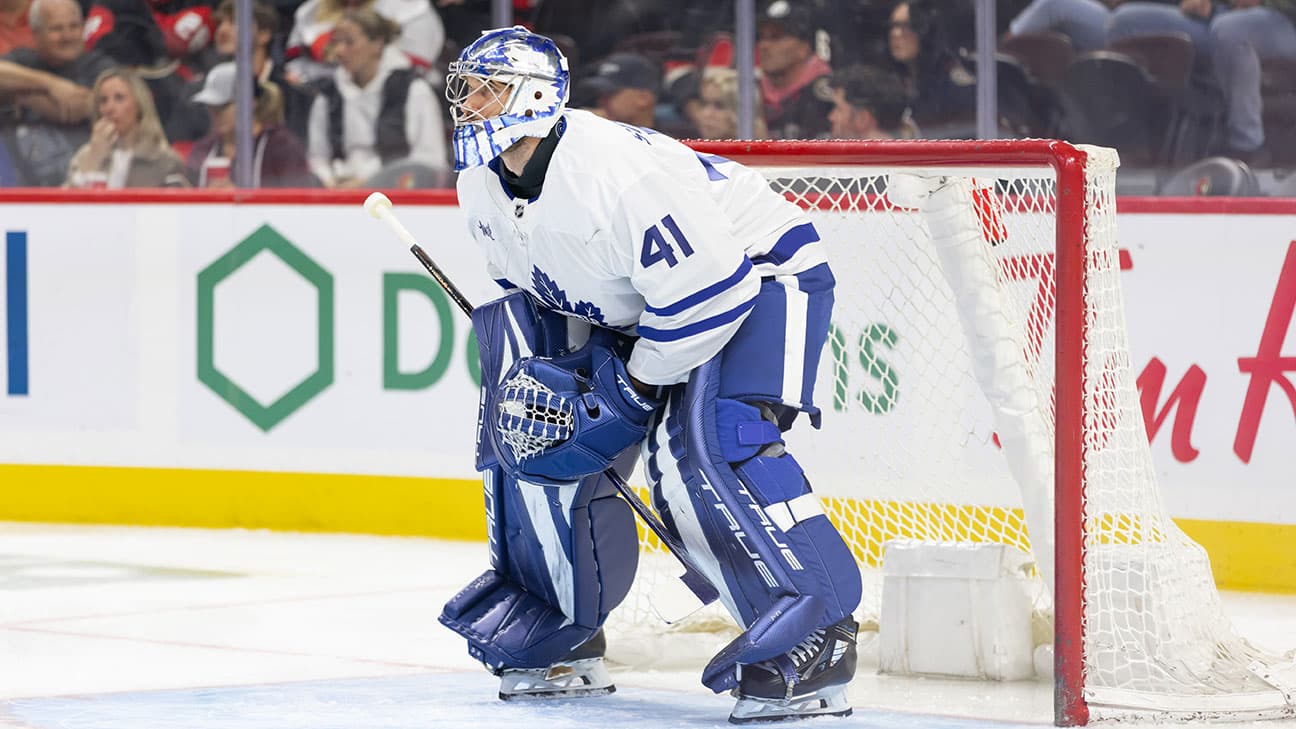
Photo: NHL.com
NHL Emergency Backup Goalie Rule: What Changes for the Maple Leafs in 2026-27
Table of Contents
The NHL emergency backup goalie rule gets a full rewrite this season
The NHL emergency backup goalie rule changes for 2026-27, and it ends one of the best traditions the sport had. Under the collective bargaining agreement that takes effect this season, every club must employ its own full-time emergency backup goaltender who travels with the team and practises with it. No more phoning the beer-league goalie in section 118. No more accountants, arena staff or Zamboni drivers dressing for an NHL game because two goalies went down in the same night.
For most of the league this is an administrative footnote. For the Toronto Maple Leafs it is something closer to a plot point, because no franchise in hockey has a more painful relationship with the old version of this rule — and because Toronto's 2026-27 goaltending situation is arguably the most likely in the league to actually need the new one.
This is a small rule with a real chance of mattering. Here is how it works, who qualifies, and why the Leafs should take the search seriously.
What the new rule actually requires
The mechanics are straightforward. Each of the 32 clubs designates one emergency backup goaltender for the season. That goaltender travels with the NHL roster and practises with the club, rather than being scrambled from the stands or the arena staff room when disaster strikes.
Critically, the designated EBUG does not count against the roster limit and does not count against the salary cap. He is a body on the payroll who is invisible to the cap sheet — which, for a team in Toronto's position, is worth pausing on. You can check the club's committed money on our Maple Leafs contracts page; the EBUG does not appear on it.
The point of the change is competitive integrity. The old system produced wonderful stories, but it also meant that a playoff-race game could hinge on a 42-year-old who had not played competitive hockey in years. The league decided the charm was not worth the risk.
The eligibility rules are stricter than most people realize
The new EBUG is not a third professional goaltender in disguise. The eligibility criteria are deliberately narrow, and they exist to stop clubs from stashing a legitimate AHL-calibre netminder outside the cap.
To qualify, an individual cannot have played an NHL game under a standard player contract, cannot have appeared in more than 80 professional games, and cannot have played professional hockey within the previous three seasons. He also cannot be on an NHL club's reserve list or restricted free agent list, and cannot have an outside contractual obligation that would prevent him from doing the job.
Read those together and a picture emerges: the target is a recently graduated university or junior goaltender, or a career minor-leaguer who stepped away from the pro game a few years ago. Good enough to take an NHL practice and not embarrass himself in relief. Not good enough — and not eligible — to be a real depth asset.
Toronto is the franchise this rule was written about
On February 22, 2020, the Carolina Hurricanes lost both James Reimer and Petr Mrazek to injury inside a single game at Scotiabank Arena, Mrazek after a collision with Kyle Clifford. Carolina turned to the emergency backup on duty that night: David Ayres, a 42-year-old Zamboni driver employed by the Toronto Marlies.
Ayres allowed goals on the first two shots he faced, then stopped the next eight as Carolina beat the Maple Leafs 6-3. He became the first emergency backup goaltender to win an NHL game and the oldest goaltender in league history to win his regular-season debut. He did it in Toronto, against Toronto, while working for Toronto's minor-league affiliate.
It remains one of the great nights in modern hockey and one of the most quietly humiliating losses in recent Leafs history. Six years later, the league has legislated the possibility of a repeat out of existence. Somewhere in the Ford Performance Centre, someone is fine with that.
Why the Maple Leafs need a real EBUG more than most teams
Every team has to designate one. Toronto has an unusually high chance of using one, and the reasons are all on the depth chart.
Sergei Bobrovsky signed a three-year, $21 million contract on July 1 to take over as the No. 1, and he is 38 years old. His new deal runs to age 40. Behind him is Anthony Stolarz, who is a genuinely good goaltender when available and who has spent roughly 200 days on injured reserve or long-term injured reserve across the past four seasons. That is the tandem: an aging starter and a partner with a long injury history, in the first 84-game season since 1993-94. We broke down the pairing in detail in our look at the Bobrovsky-Stolarz tandem for 2026-27.
The third man is Artur Akhtyamov, who is expected to open the year with the Marlies after a spectacular Calder Cup run — 15-7 with a 2.22 goals-against average and a .923 save percentage in the playoffs, plus the Jack A. Butterfield Trophy as postseason MVP. He is the emergency recall, not the emergency backup, and his development matters on its own terms, as we covered in our piece on Akhtyamov's path through the Leafs goalie pipeline.
Then the depth thins out fast. Dennis Hildeby, the organization's other established option, went to Tampa Bay on July 1 as part of the Nick Paul trade. Toronto traded away goaltending depth in a summer when the league started requiring an extra goaltender in the building.
A salary the salary cap never sees
Here is the part that should interest a club sitting roughly $2.75 million over the upper limit: the EBUG's compensation is real money that does not touch the cap.
That does not solve Toronto's compliance problem — nothing about this rule does, and the paths to getting compliant still run through long-term injured reserve or a trade, as we laid out in our breakdown of the Leafs' $2.75 million overage. But it is a rare case in the modern NHL where a club can spend on hockey infrastructure without a cap consequence, and a well-run organization will treat the job as a real hire rather than a box to tick.
The practical value is in practice, not games. A designated goaltender who travels and takes reps means Bobrovsky and Stolarz do not have to absorb every drill on every day of an 84-game season with a compressed schedule. Over a full year, that is meaningful load management for a 38-year-old starter.
What Toronto should be looking for
The eligibility window points at a specific profile: a recent U SPORTS or NCAA graduate from the Ontario area, or a former junior starter who left the pro track two or three seasons ago and has stayed in shape. Someone who can handle a full NHL practice at tempo, hold up in a shooting drill against Auston Matthews and William Nylander, and live out of a suitcase from late September to April without complaint.
There is no glory in the job and very little chance of playing. The odds of both Bobrovsky and Stolarz going down in the same game are small. But the odds are not zero, and Toronto is the team that learned in the most public way possible what happens when the emergency plan is whoever happens to be in the building.
What's next
Clubs are expected to have their designated emergency goaltenders in place for the start of the season, with the 2026-27 schedule opening in late September. Toronto has not publicly named its choice, and it is the kind of hire that typically gets announced in a transaction note rather than a press conference.
Watch for the name to surface around training camp, when the Leafs finalize their staff for an 84-game grind. It will be the least important signing of the Maple Leafs' summer right up until the night it is not.
Frequently Asked Questions
What is the new NHL emergency backup goalie rule for 2026-27?
Under the CBA that takes effect in 2026-27, every NHL club must employ a full-time emergency backup goaltender who travels with the team and practises with it. The designated EBUG does not count against the roster limit or the salary cap. It replaces the old system of using local amateurs or arena staff on a game-by-game basis.
Who is eligible to be an NHL emergency backup goalie?
The individual cannot have played an NHL game under a standard player contract, cannot have appeared in more than 80 professional games, and cannot have played professional hockey in the previous three seasons. He also cannot be on an NHL club's reserve list or restricted free agent list. The criteria are designed to prevent teams from stashing a legitimate pro goaltender outside the cap.
Does the emergency backup goalie count against the NHL salary cap?
No. The designated EBUG counts against neither the roster limit nor the salary cap, even though he travels with the club and practises with it. It is one of the few places in the modern NHL where a team can spend real money on a hockey role with no cap consequence.
Who was David Ayres and what did he do to the Maple Leafs?
David Ayres was a 42-year-old Zamboni driver for the Toronto Marlies who dressed as Carolina's emergency backup on February 22, 2020, after both James Reimer and Petr Mrazek were injured. He stopped eight of the last 10 shots he faced in a 6-3 Hurricanes win at Scotiabank Arena, becoming the first EBUG to win an NHL game and the oldest goalie to win his regular-season debut.
Who are the Maple Leafs goalies for the 2026-27 season?
Sergei Bobrovsky, signed to a three-year, $21 million contract on July 1, is the projected No. 1 at age 38. Anthony Stolarz is the No. 2. Artur Akhtyamov, the 2026 Calder Cup playoff MVP, is expected to start the season with the Marlies as the first recall.
Why do the Maple Leafs need a full-time EBUG more than other teams?
Toronto's tandem pairs a 38-year-old starter with a backup who has spent roughly 200 days on injured reserve or LTIR over the past four seasons, in the league's first 84-game season since 1993-94. The Leafs also traded goaltending depth in Dennis Hildeby to Tampa Bay on July 1 as part of the Nick Paul deal.
When does the 2026-27 NHL season start?
The 2026-27 regular season opens in late September, with the first games scheduled for September 29 as part of the new 84-game format. Toronto's preseason begins earlier, on September 19 with a split-squad date against Montreal.


