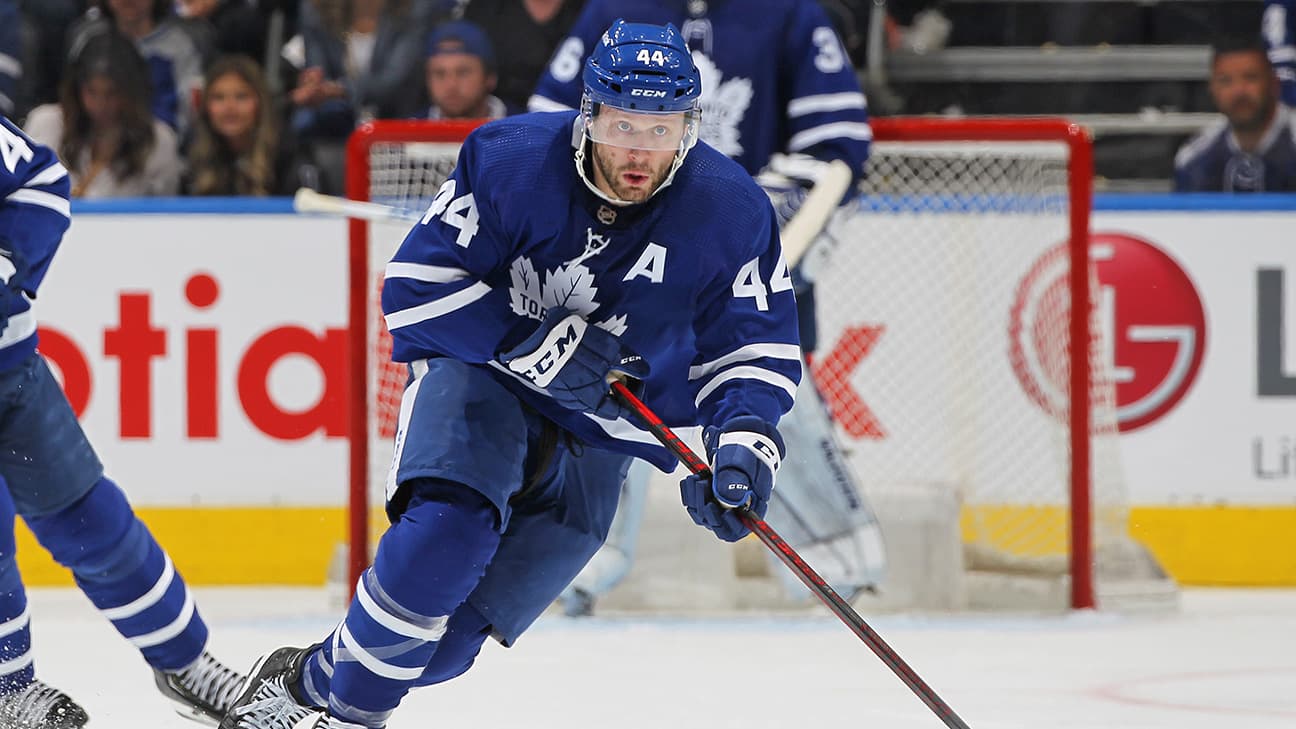
Photo: NHL.com
The Maple Leafs Offseason To-Do List Now That the Draft Is Done
Table of Contents
The Maple Leafs Offseason Enters Its Busiest Week
The draft is over, Gavin McKenna is a Maple Leaf, and the Maple Leafs offseason now hits its most compressed stretch of the calendar. Between Saturday's final draft rounds and the opening of free agency on July 1, John Chayka has roughly four days to settle a qualifying-offer deadline, resolve a Morgan Rielly situation, sort out the goaltending depth and figure out how to spend about $18.8 million in cap space in a thin market. Here is the to-do list, in the order it actually comes due.
None of this is hypothetical. Every item below has a real deadline or a real pressure point, and how Chayka handles them will define whether this summer reads as a clean retool or a missed window.
1. The June 29 Qualifying-Offer Deadline
The first hard date is Monday, June 29 — the deadline to extend qualifying offers to restricted free agents. The Leafs have already used this lever to clear out Samuel Ersson, whose rights they traded to Ottawa rather than qualify. The remaining calls are more interesting. Nick Robertson and Matias Maccelli are the names that matter, and each comes with a genuine decision about term, trade value and whether the player fits the roster Chayka is building.
We dug into the math in our look at the Robertson and Maccelli qualifying decisions, and the short version is that a qualifying offer is not a formality. Qualify a player and you keep his rights but commit to a number; decline and he walks for nothing. Expect at least one of these calls to surprise people.
2. Resolve the Morgan Rielly Situation
Rielly is the biggest unresolved piece on the board. His agent has submitted a Western-Conference-heavy list of teams he would accept a trade to, with San Jose and Anaheim repeatedly mentioned as fits — the Sharks in particular have more than $40 million in cap space and a young core that could use a veteran puck-mover. We tracked the latest in our Rielly trade-list breakdown.
The complication is the contract: a $7.5 million cap hit and a full no-move clause that limits Toronto's leverage and may force the Leafs to retain salary to make a deal work. Moving Rielly would free up significant money before July 1 and reshape the blue line around the newly acquired Darren Raddysh and Emil Andrae. Not moving him is also fine — but Chayka needs to know which way it is going before he shops in free agency, because the answer changes how much he has to spend.
3. Settle the Goaltending Behind Stolarz
With Ersson gone, the crease is suddenly a priority. Anthony Stolarz is the starter, but he has never started more than 33 games in a season, and the schedule grows to 84 games in 2026-27. Behind him sit Dennis Hildeby, who played 20 NHL games in 2025-26, and Artur Akhtyamov, and neither has carried an NHL workload.
That is not a tandem a serious team rides into October untouched. The likeliest fix is a cheap, short-term veteran backup signed in free agency — insurance that lets Toronto develop its young goalies without betting the season on them. The crease is the part of this roster with the widest gap between "fine" and "problem," and we mapped it out in our goaltending breakdown.
4. Find Centre Depth in a Bone-Dry Market
The Leafs need help down the middle behind Auston Matthews and John Tavares, and the timing is brutal. This year's unrestricted free-agent class is one of the thinnest in years, especially at centre, which pushes the cost of the few available bodies up and pushes Chayka toward the trade market for real solutions. The roughly $18.8 million in cap space sounds like a lot until you remember how few impact centres are actually available to spend it on.
Expect Chayka to be patient here rather than overpay on July 1 for a middle-six centre who will look bad on the books by year two. Discipline in a thin market is its own kind of strategy. Track the full cap picture on the contracts page.
5. Sign Gavin McKenna and Plan His Season
The pleasant item on the list: getting McKenna under contract. Toronto holds his rights and is expected to sign him to a three-year entry-level deal in the coming weeks. The bigger question is the development plan — whether he makes the roster out of camp, gets a nine-game NHL look, or returns to junior eligibility. None of that needs to be solved this week, but it is the through-line connecting this offseason to the next half-decade.
For the long view on what Toronto is getting, revisit our coverage of the McKenna selection and the draft hub.
6. Decide Whether Anthony Stolarz Is the Starter or a Trade Chip
Hovering over the whole goaltending file is the starter himself. His contract is not the question: Anthony Stolarz signed a four-year extension in September 2025 at $3.75 million a year, running through 2029-30. The question is his role. His name has surfaced in trade chatter even as the team publicly backs him as the No. 1 for 2026-27, so Toronto has to decide whether to build the crease around him or listen to offers while his value is intact.
This is the kind of medium-term question that does not have a June 29 or July 1 deadline attached, which is exactly why it can get lost in a busy week. But it shapes everything else in the crease. If the Leafs are committed to Stolarz, the priority is a backup. If they are open to moving him, the calculus on Akhtyamov, Hildeby and a free-agent goalie changes entirely. We weighed both sides in our argument that the Leafs should only deal Stolarz for a genuine upgrade.
The Cap Math Tying It All Together
Every item on this list runs through the same number: roughly $18.8 million in space against a $104 million cap. That figure is healthy, but it is not infinite, and it has to cover a centre, a backup goalie, depth signings and any qualifying-offer commitments — all while leaving room for in-season flexibility. A Rielly trade would add another $7.5 million to work with, which is why resolving his situation is the domino that determines how aggressive Chayka can be everywhere else.
The temptation in a thin market is to spend the space just because you have it. The smarter play is to treat July 1 as the start of a longer process, not a single shopping spree, and to keep powder dry for the trade market where the real centre help lives. Discipline has defined this offseason. The cap sheet is where it gets tested.
What to Watch as Free Agency Opens
The next four days are the busiest of Chayka's first summer. The qualifying-offer deadline lands Monday, the Rielly question needs an answer, the crease needs a body, and the centre market opens Wednesday in the worst possible year to be shopping for one. The Maple Leafs offseason has been disciplined and asset-conscious to this point. This is the week that tests whether that discipline survives contact with free agency. Keep the standings and roster pages bookmarked — by next weekend, this roster will look different again.
Correction, Oct. 3, 2026: An earlier version said Anthony Stolarz was heading toward unrestricted free agency. He signed a four-year, $3.75 million AAV extension in September 2025 that runs through 2029-30. It also described Dennis Hildeby as coming off strong Marlies seasons; he played 20 NHL games in 2025-26.
Frequently Asked Questions
What is the Maple Leafs' qualifying-offer deadline in 2026?
The deadline to extend qualifying offers to restricted free agents is June 29, 2026. Toronto's key remaining decisions involve Nick Robertson and Matias Maccelli, after the team already moved Samuel Ersson rather than qualify him.
When does NHL free agency open in 2026?
Unrestricted free agency opens on July 1, 2026. The Maple Leafs enter it with roughly $18.8 million in cap space against a $104 million salary cap, in one of the thinnest UFA classes in years.
How much cap space do the Maple Leafs have in 2026?
Toronto is carrying approximately $18.8 million in cap space heading into free agency. A Morgan Rielly trade, which would shed his $7.5 million cap hit, could increase that figure before or after July 1.
Do the Maple Leafs need a new goaltender?
They need depth. Anthony Stolarz is the starter but has never started more than 33 games in a season, and behind him sit Dennis Hildeby (20 NHL games in 2025-26) and Artur Akhtyamov. With the schedule at 84 games, Toronto is expected to add a veteran backup in free agency.
What positions do the Maple Leafs need to fill this offseason?
The priorities are centre depth behind Auston Matthews and John Tavares, a veteran backup goaltender behind Stolarz, and clarity on the blue line depending on whether Morgan Rielly is traded. The thin free-agent market pushes Toronto toward the trade route for impact help.
Has Gavin McKenna signed with the Maple Leafs yet?
Not as of the draft. Toronto holds his rights and is expected to sign him to a three-year entry-level contract in the coming weeks, with his 2026-27 development path to be decided at training camp.


