How the Leafs' 2025-26 Season Came Apart — Start to Finish
Analysis

How the Leafs' 2025-26 Season Came Apart — Start to Finish

LeafsLurkerApr 18, 20267 min read

Table of Contents

Sponsored

Enjoying this article?

Check out our recommended products and services.

Learn More

The nine-season streak, snapped

On April 2, 2026, the Toronto Maple Leafs were mathematically eliminated from the playoffs. It was the first time they'd missed since 2015-16 — a nine-season streak that outlived three general managers, two head coaches and roughly half a roster. By the time the regular season ended two weeks later, they had finished fifth-last in the league, locked into the best lottery odds the franchise had held in the Matthews-Nylander era.

The postmortem didn't require a lot of creativity. You could see it coming from July, if you were looking. This is how it happened.

July 1, 2025: The Marner trade

Mitch Marner went to Vegas in a sign-and-trade on the day free agency opened. He had put up 102 points in 2024-25. The Leafs got back about $10.9M of cap space, plus futures. They never got back the 102 points.

The offseason plan, as it played out in the first forty-eight hours of free agency, was to replace one 100-point winger with three competent NHL forwards. Matias Maccelli arrived from Utah on June 30 for a conditional 2027 third. Dakota Joshua came from Vancouver on July 17 for a 2028 fourth. Nicolas Roy, slightly later, came in on the kind of depth-center move Toronto has made a dozen of. All three are useful players. None of them is Mitch Marner.

The theory — more balance, less top-heavy — wasn't crazy. The execution needed Auston Matthews to be healthy and scoring in the Matthews range. That assumption didn't hold.

The Matthews problem

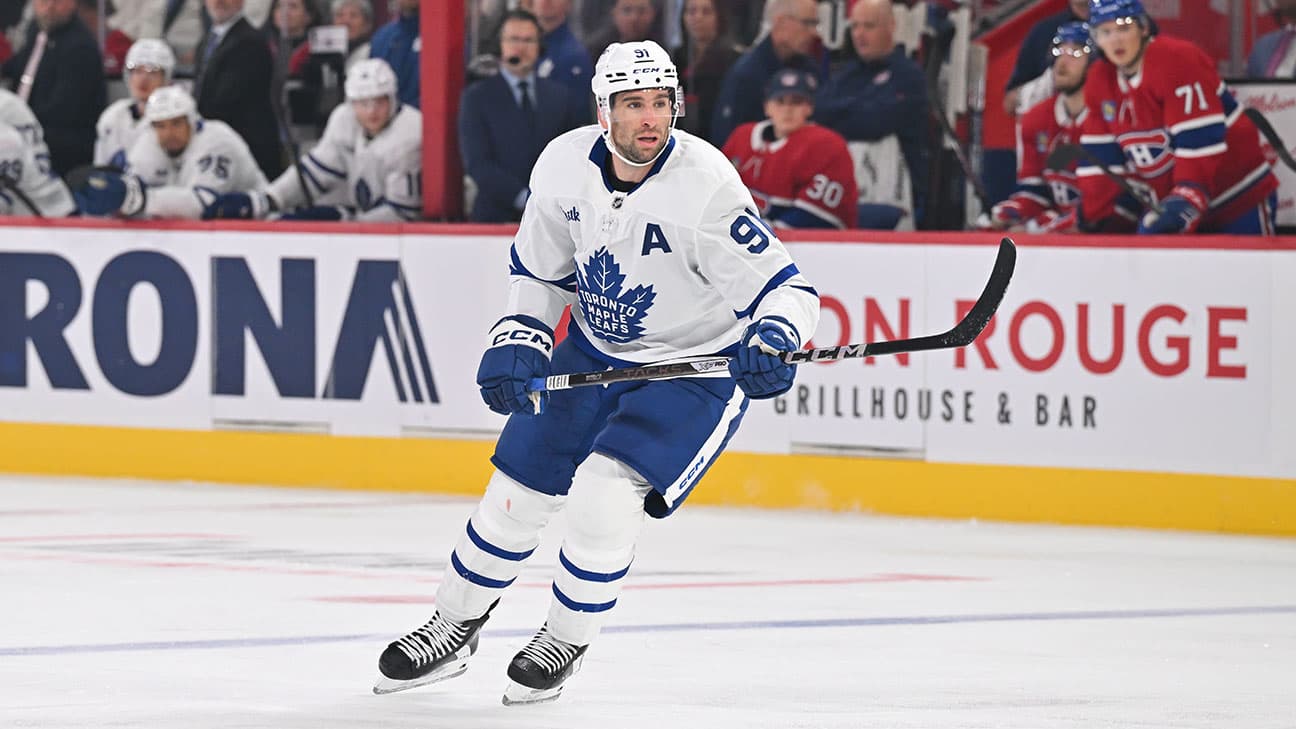
Matthews didn't look right from October. By the time he went down for the year on March 14 with a grade-3 MCL tear — a knee-on-knee collision with Anaheim's Radko Gudas — he had 27 goals and 26 assists in 60 games. By his standards that line reads like a down year; in the context of the 2025-26 Leafs it was the offense carrying the offense, and it still wasn't enough.

There was one clean week in the middle of all of it. Matthews captained Team USA to Olympic gold in Milan in February, scoring in the final. The tournament showed a version of him the Leafs hadn't seen all year. Three weeks later he was in a brace.

The injury was bad luck. The context around the injury was not. The Leafs had built a roster that could survive a Matthews dip but not a Matthews absence, because the secondary scoring they'd spent the summer acquiring hadn't yet clicked. When he went down, the team cratered.

Berube's north-south diet, year two

Craig Berube's first season had gone well. The Leafs finished first in the Atlantic in 2024-25 on a north-south identity: forechecking, cycling, low-event hockey that suited a top-heavy lineup. Through year one, the system was the story. Through year two, it became the thing the players kept abandoning.

Berube said it publicly more than once. The Leafs were too east-west, too freelance, too willing to turn pucks over through the neutral zone in the name of a play that wasn't there. When it worked, the top line produced. When it didn't — which was more of the year than anyone wanted — the defense got hung out on odd-man rushes that Joseph Woll and Anthony Stolarz were not equipped to bail out forever.

By February the structural issues were not theoretical. They showed up in the goals-against numbers, the penalty-kill numbers, and the coach's press-conference tone. The system was fine. The group was not playing the system.

Nylander carrying water

William Nylander had the best full season of his career on the worst Leafs team in a decade. He led the team in scoring — 26 goals and 46 assists in 59 games, just over a point a game — and he did it while the other top-six forwards were a mix of injured, underperforming, and adjusting. The eight-year contract he signed in January 2024 at $11.5M AAV, which was treated as expensive at the time, now looks like the foundational deal on the team. It runs through 2032.

He was the exception to the rule. For most of the top-nine, this was a lost year — by statistical expectation if nothing else.

The deadline: seller, for the first time in a decade

On March 5 the Leafs shipped Nicolas Roy to Colorado for a conditional 2027 first (or 2028 first, depending on Leafs' own 2027 pick placement) and a conditional 2026 fifth. The next day, Bobby McMann went to Seattle for a conditional 2027 second and a 2026 fourth. Also on March 6, Anaheim's 2026 fourth came back in a separate move.

Then the deadline proper hit, and Scott Laughton — who had been acquired in the previous deadline cycle — moved on as well. For the first time in something like a decade, the Toronto Maple Leafs were a seller.

Brad Treliving said at his podium that the blame started with him. That's the GM's line and the GM probably meant it, but it was also a signal — the team was finally willing to read the scoreboard and act on it. For nine years, regardless of how any season was tracking in late February, the Leafs added at the deadline. This year they subtracted. It was, on paper, the first honest offseason the front office had run since 2017.

What's in the cupboard now

The standings damage produced one real consolation prize: fifth-last overall, with 41.8% lottery odds to keep the top-5-protected 2026 first that was conditionally traded to Boston in the Brandon Carlo deal. If the pick lands top-5, the Leafs get a real prospect. If it doesn't, Boston does, and the Leafs continue to owe out through 2028 per the draft pick page.

The cap sheet tells the other half of the story. Matthews, Nylander, Knies, Tavares and Rielly are all locked in at varying degrees of length and term. Carlo and McCabe anchor the defense through 2027 and 2030. Stolarz and Woll are both under contract. The team that missed the playoffs is, substantially, the team that will start next season — plus whatever Treliving does with the Marner-money players and the two RFAs (Maccelli, Robertson) who need new deals.

What it meant

Missing the playoffs in 2025-26 broke a streak, but it didn't break the core. Matthews is 28. Nylander is 29 and under contract through 2032. Knies is 23. Rielly is still the best skating defenseman they've had since the Kadri years. The structural problems — system discipline, goaltending depth, third-line production — are the kind of problems a working front office can fix in a summer.

The question that lingered into April, the one people in Toronto were already asking on talk radio by mid-March, is whether the front office and the coach are the people who are going to fix them. That part wasn't answered by the end of the season. It'll be the first story of the offseason — and the blog will cover it as it unspools.

The short version

Marner left on July 1. The replacements didn't add up. Matthews didn't have his usual year and then got hurt. Berube's system didn't hold. Nylander was great. The deadline was a sell. The lottery is in May. The real work starts in July.

Nine years was a nice run. The next one starts now.

Sponsored

Want to stay updated?

Subscribe to our newsletter for the latest content.

Subscribe

Frequently Asked Questions

When were the Leafs eliminated from the 2025-26 playoffs?

Toronto was mathematically eliminated on April 2, 2026 — the first time the Leafs missed the playoffs since the 2015-16 season, breaking a nine-year postseason streak.

What happened with Auston Matthews' injury in 2025-26?

Matthews tore the MCL in his right knee in a grade-3 injury on March 14, 2026 after a knee-on-knee collision with Anaheim's Radko Gudas. He was ruled out for the remainder of the regular season. Before the injury he had 53 points (27G, 26A) in 60 games.

Why did the Leafs trade Mitch Marner?

Marner went to the Vegas Golden Knights in a sign-and-trade on July 1, 2025. The Leafs freed up roughly $10.9M in cap space, which they used to sign forwards Matias Maccelli, Dakota Joshua and Nicolas Roy rather than replace Marner with a single top-line forward.

Were the Leafs buyers or sellers at the 2026 trade deadline?

Sellers, for the first time in nearly a decade. Toronto moved out Nicolas Roy (to Colorado for a conditional 2027 1st), Bobby McMann (to Seattle for a conditional 2027 2nd and 2026 4th), and earlier dealt Scott Laughton. GM Brad Treliving said the blame for the lost season 'starts with me.'

Who led the Leafs in scoring in 2025-26?

William Nylander, who posted 72 points (26G, 46A) in 59 games on the year — his best full season to date. His $11.5M AAV contract runs through the 2031-32 season.

Where did the Leafs finish in the 2025-26 NHL standings?

Fifth-last in the league overall, locking in the best lottery odds the franchise has held in the Matthews-Nylander era. They hold a 41.8% chance of keeping their top-5-protected 2026 first-round pick, which was conditionally traded to Boston in the Brandon Carlo deal.

Share this article